Firewater Network Engineering and Equipment Specification
We deliver end to end firewater system engineering covering layout, pump house, tanks, hydrants, monitors, foam and the civil and structural integration that ties it all together
Firewater Network Engineering
and Equipment Specification
Firewater network engineering is the full detailed engineering scope that turns a hydraulically validated design basis into a firewater system your team can actually build. Where hydraulic modelling is a separate calculation discipline that sizes pumps and validates pressures, network engineering produces the layout drawings, equipment specifications, civil and structural details, electrical and instrumentation integration and procurement packages that carry the design from calculation through to construction. Our work spans ring main routing with sectional isolation, pump house architecture combining an electric main pump, a diesel backup and a jockey pump per NFPA 20, atmospheric or pressurised tank storage with corrosion and coating selection, hydrant and monitor placement matched to scenario reach, foam water deluge skids per NFPA 11 and 16, area protection systems for tank farms and process units, and full integration with detection and activation logic and your emergency response procedures. Beyond the mechanical design, our team also assembles the regulatory submission packages for TAC India, OISD STD 116, AHJ fire marshal reviews and FM Global HPR tier qualification dossiers.
Firewater Network Engineering and Equipment Specification workflow
Calculate fire demand per NFPA 13 (sprinkler) / NFPA 15 (water spray) / NFPA 16 (foam water) / NFPA 24 (private fire main), apply credible worst case scenario from FERA, single largest fire, two area simultaneous, hose stream allowance.
Design firewater network per NFPA 24, looped main with sectional isolation valves, hydrant spacing per FM DS 4 1 (typically 60 to 90m), monitor placement for cooling and exposure protection, align with site layout and access.
Design fire pump house per NFPA 20, electric main pump + diesel backup, jockey pump for pressure maintenance, pump house ventilation, fuel storage (typical 4 hour supply), align with NEMA / IEC enclosure ratings.
Size firewater storage per credible worst case scenario duration (typical 4 hour minimum per NFPA / FM), specify tank type (vertical bolted, welded, RCC, FRP), tank coating per environment, water quality maintenance (algicide, biocide).
Integrate firewater system with detection and activation, manual call points, deluge valves per NFPA 15 / 16 (pneumatic / electric / hydraulic), cause and effect logic per ISA TR84.00.07, align with F&G and ESD systems.
Commission firewater per NFPA 25, flushing, pressure testing, flow testing, deluge spray pattern verification, design ITM programme (weekly visual, monthly pump test, annual full flow test), align with FM Global HPR / insurer requirements.
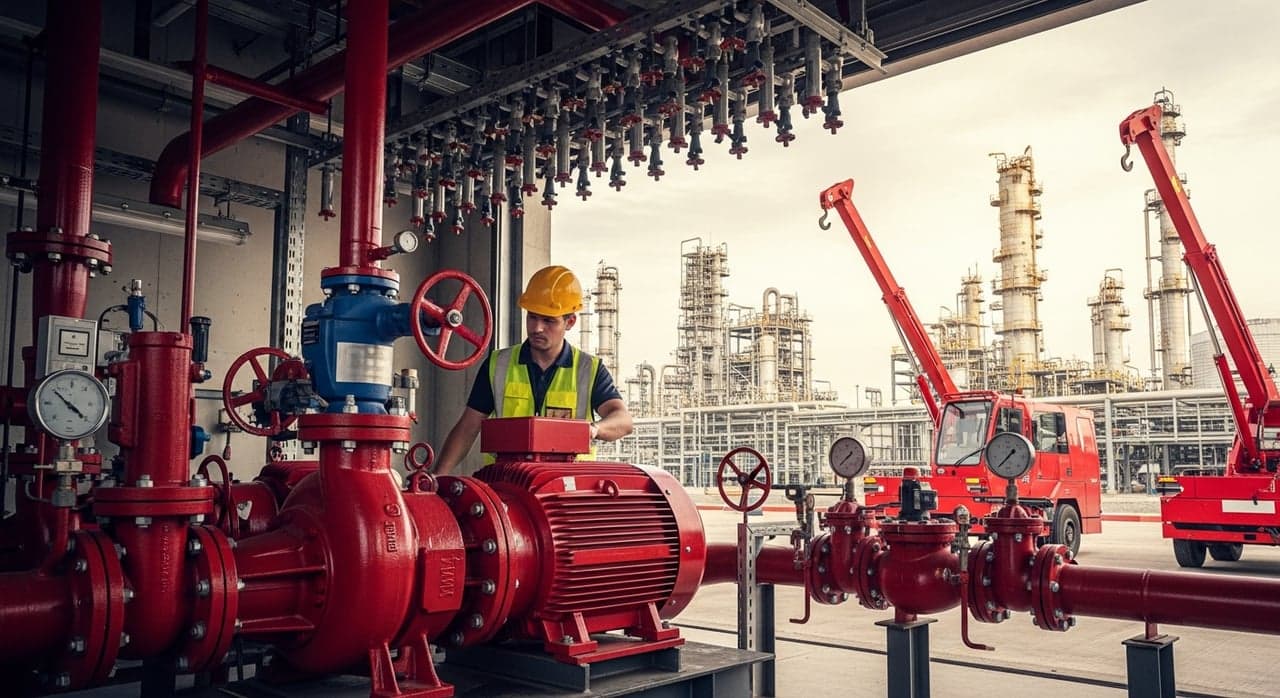
Every deliverable from basis to handover
Complete Firewater Network Engineering and Equipment Specification scope covering every calculation, drawing, specification, and construction support activity.
Outcomes of Firewater Network Engineering and Equipment Specification
- We confirm firewater is available for every credible scenario
- We validate the coverage and reach of your hydrants and monitors
- We tighten exposure protection across the plant
- We make sure the system supports a ready emergency response
- We design to NFPA 24 and 20
- We document OISD STD 116 compliance
- We support your TAC India ratings
- We produce a dossier that holds up to AHJ and insurer review
- We strengthen your inspection, testing and maintenance regime
- We find the pressure drop bottlenecks in the network
- We make your drills more realistic
- We support periodic flow testing
- We right size pump and storage capacity
- We give your insurer documented protection to assess
- We target retrofit capital at the weakest links
- We lower your business interruption exposure
Codes & standards we work to
Triggers that signal the need
Where Firewater Network Engineering and Equipment Specification applies
Tangible deliverables
- Firewater design basis and equipment list
- Network layout drawings with isolation valve placement
- Pump house general arrangement and equipment specifications
- Atmospheric and pressurised tank design package
- Hydrant and monitor placement plan with coverage map
- Foam water deluge skid specifications
- Area protection schemes for the tank farm and process units
- Civil, structural, electrical and instrumentation interface drawings
- TAC, OISD, AHJ and FM Global submission dossier
- Procurement specifications for major equipment
Send us the scope
We will scope Firewater Network Engineering and Equipment Specification against your site and come back with what it would take. Send us the process conditions, the equipment list and the stage the design has reached.