Source term characterisation
Discharge modelling for sub cooled, saturated and two phase inventories. Choked and unchoked regimes, isenthalpic flash fraction, aerosol rainout and pool spreading with conductive and convective substrate heat transfer.
One environment from release to risk contour, with the assumptions carried on the record
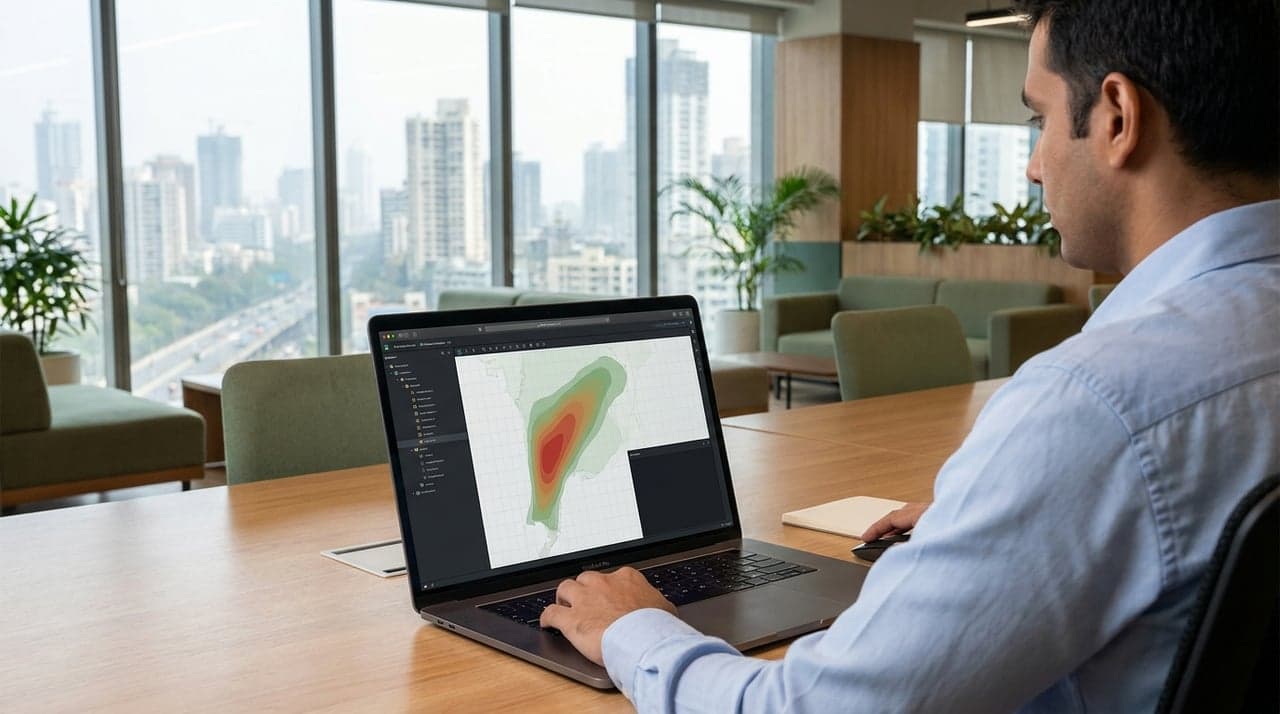
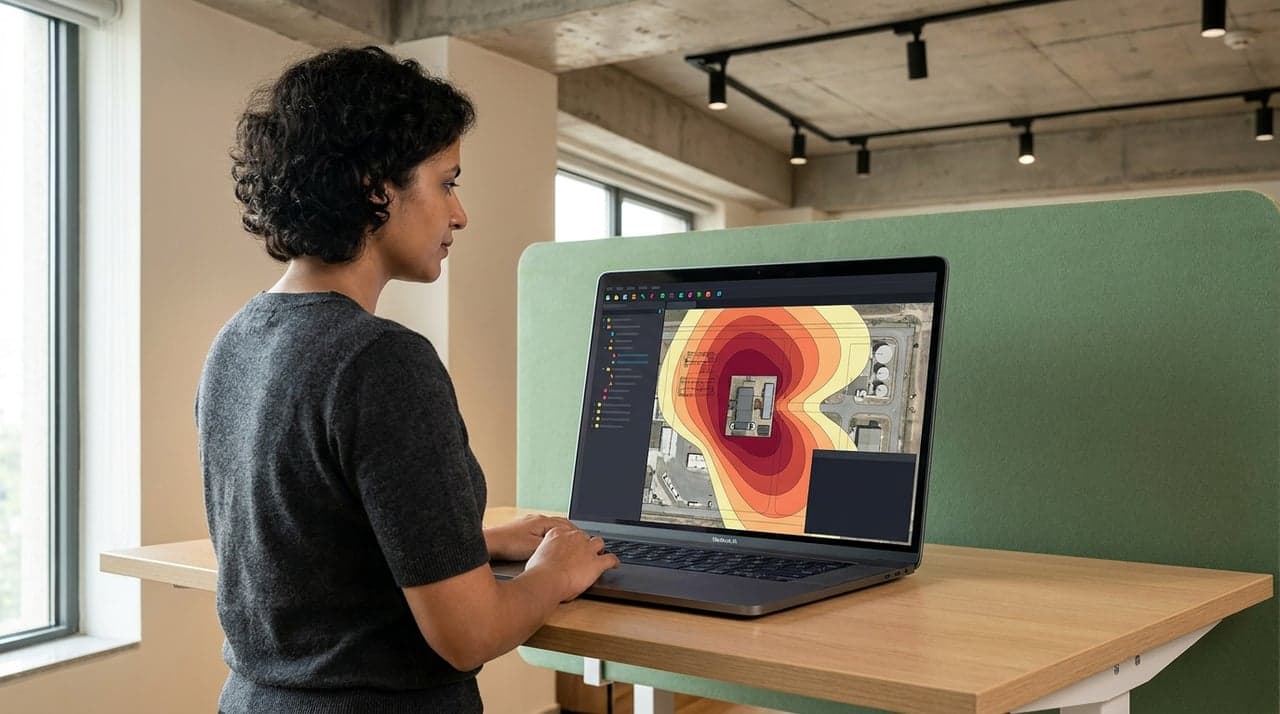
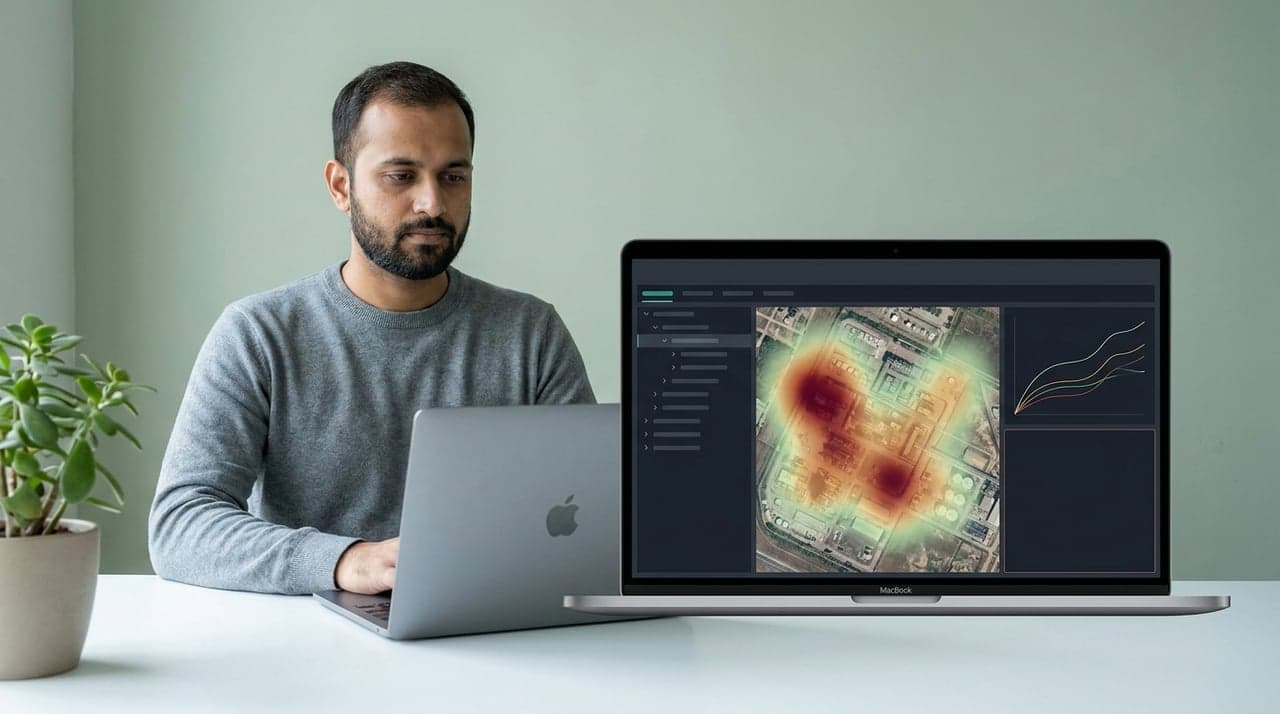
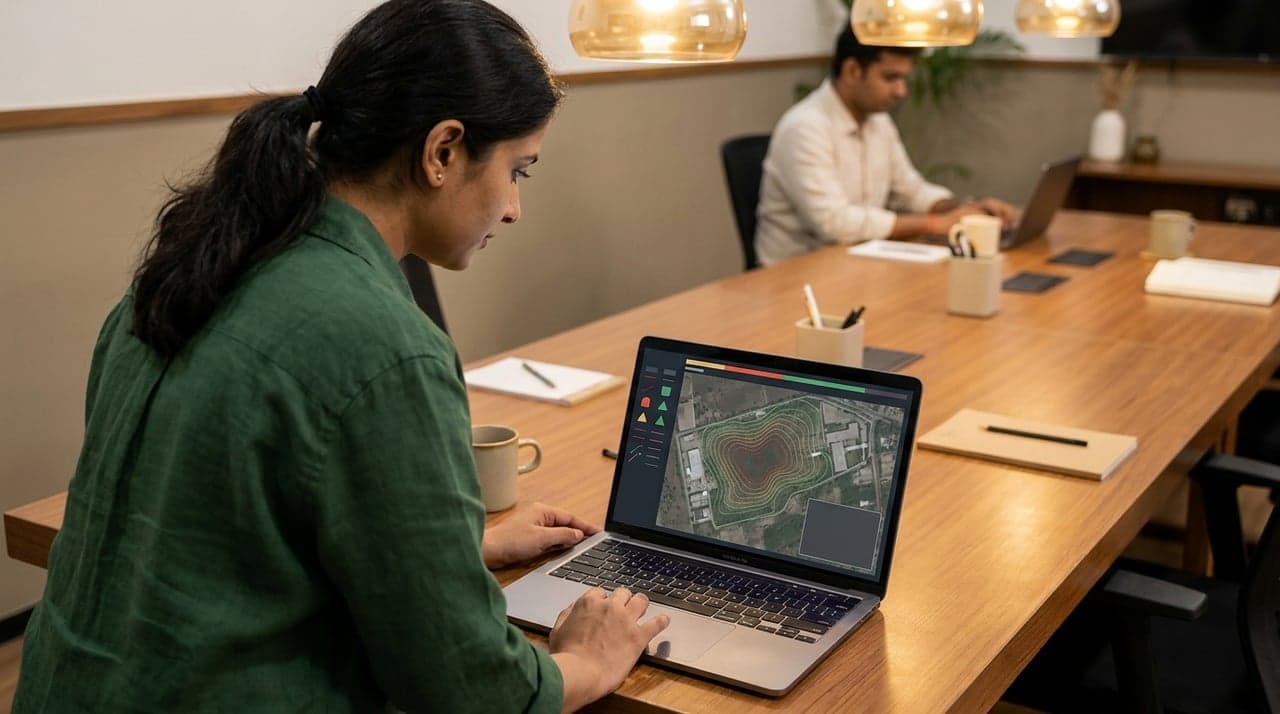
AQRA holds source term, dispersion, effect and risk summation on one case, so any number on any output can be walked back to the release that generated it. Where a chain is split across tools the assumptions that produced a contour are carried by hand between them, and a contour that reaches a drawing arrives without the basis that justifies it.
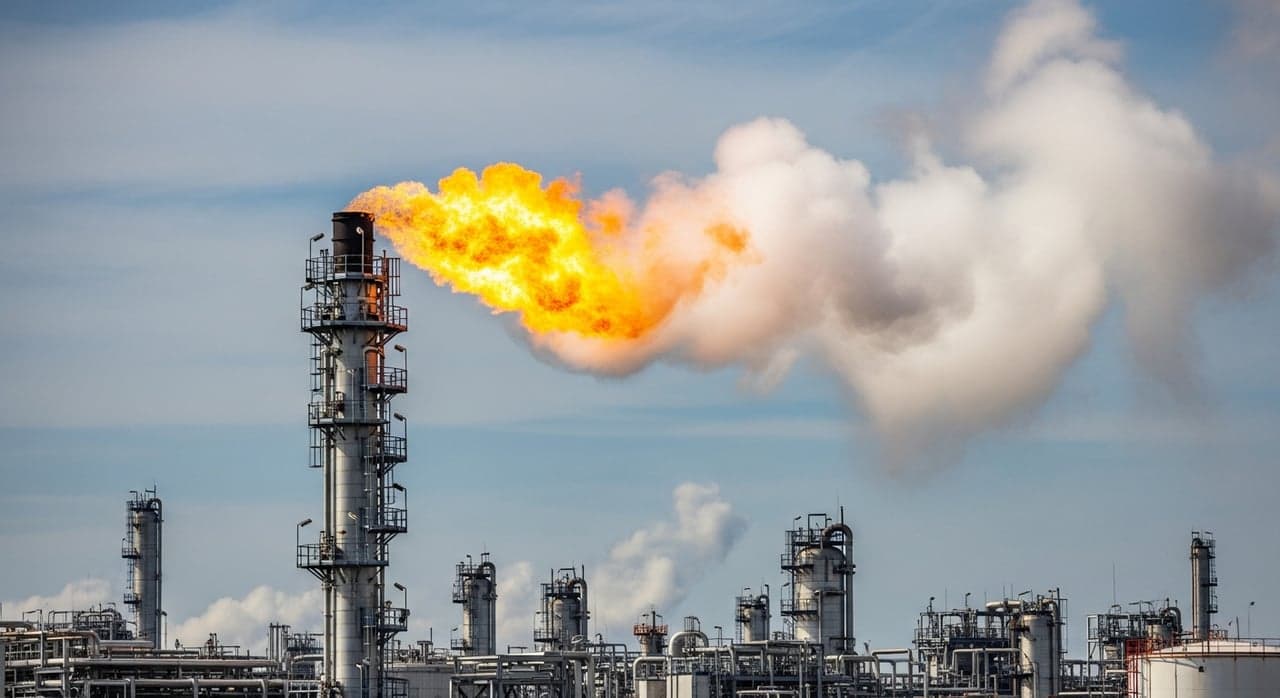
Each stage writes its selected correlation, its validity range and its assumption set into the case, and the next stage reads them from there rather than from a re entered copy.
Discharge modelling for sub cooled, saturated and two phase inventories. Choked and unchoked regimes, isenthalpic flash fraction, aerosol rainout and pool spreading with conductive and convective substrate heat transfer.
Momentum dominated near field jet with air entrainment, gravity driven slumping where the cloud is negatively buoyant, and passive Gaussian far field. Pasquill Gifford stability with surface roughness and averaging time correction.
Jet and pool fire by solid flame radiation with view factor and atmospheric transmissivity, BLEVE fireball diameter and duration, flash fire envelope to the lower flammable limit, and vapour cloud overpressure by congestion and confinement assessment.
Probit transformation of thermal dose in kilowatt per square metre to the four thirds power second, side on and reflected overpressure, and toxic load integrated under Haber's rule with substance specific exponent.
Frequency weighted summation across release cases, hole size bands, wind sectors and stability classes. Location specific individual risk, individual risk per annum against occupancy, and cumulative societal risk.
Occupied building exceedance assessment to API RP 752 and 753, blast resistant design basis derivation, and fire and gas detector coverage optimisation against the same scenario set.
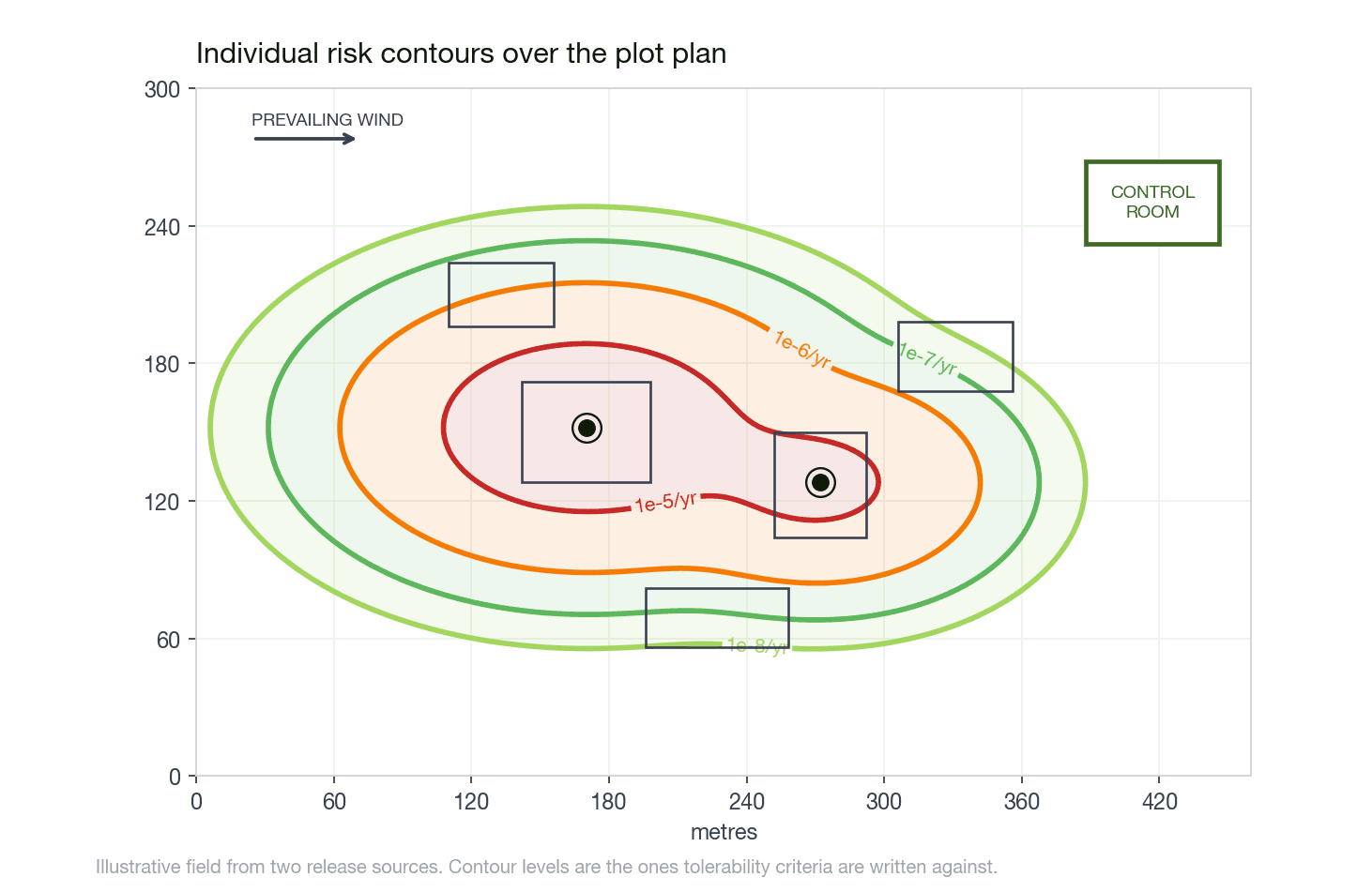
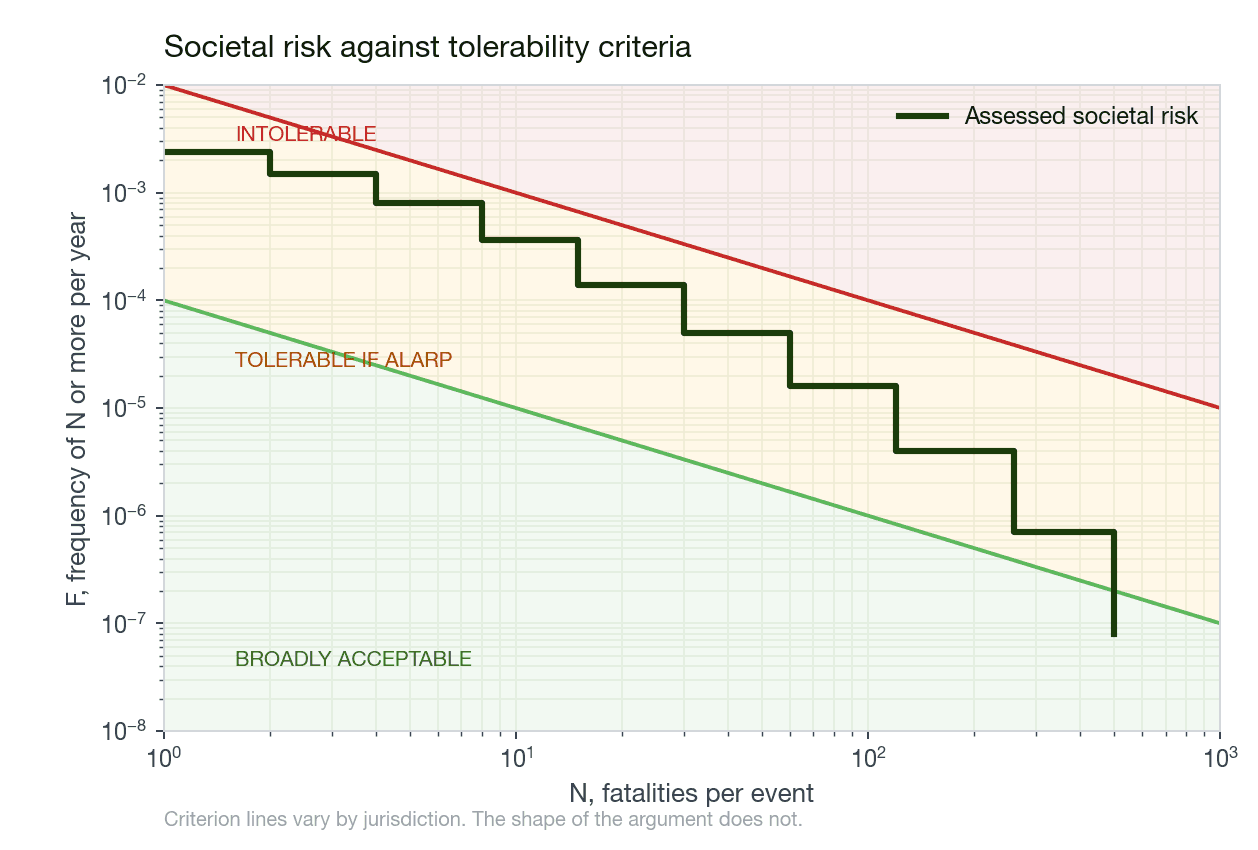
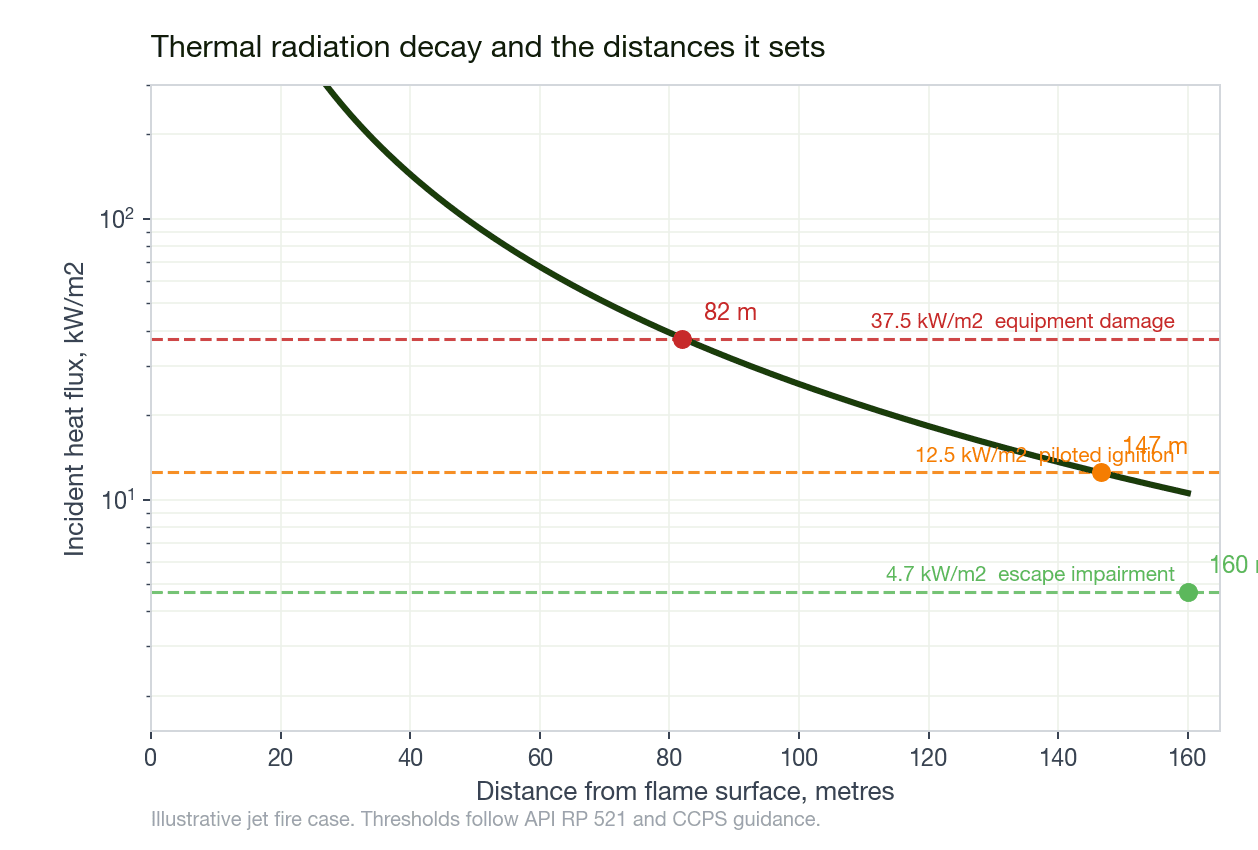
Each correlation is stated with the data it was fitted to, the range it holds over and the conditions under which it stops holding.
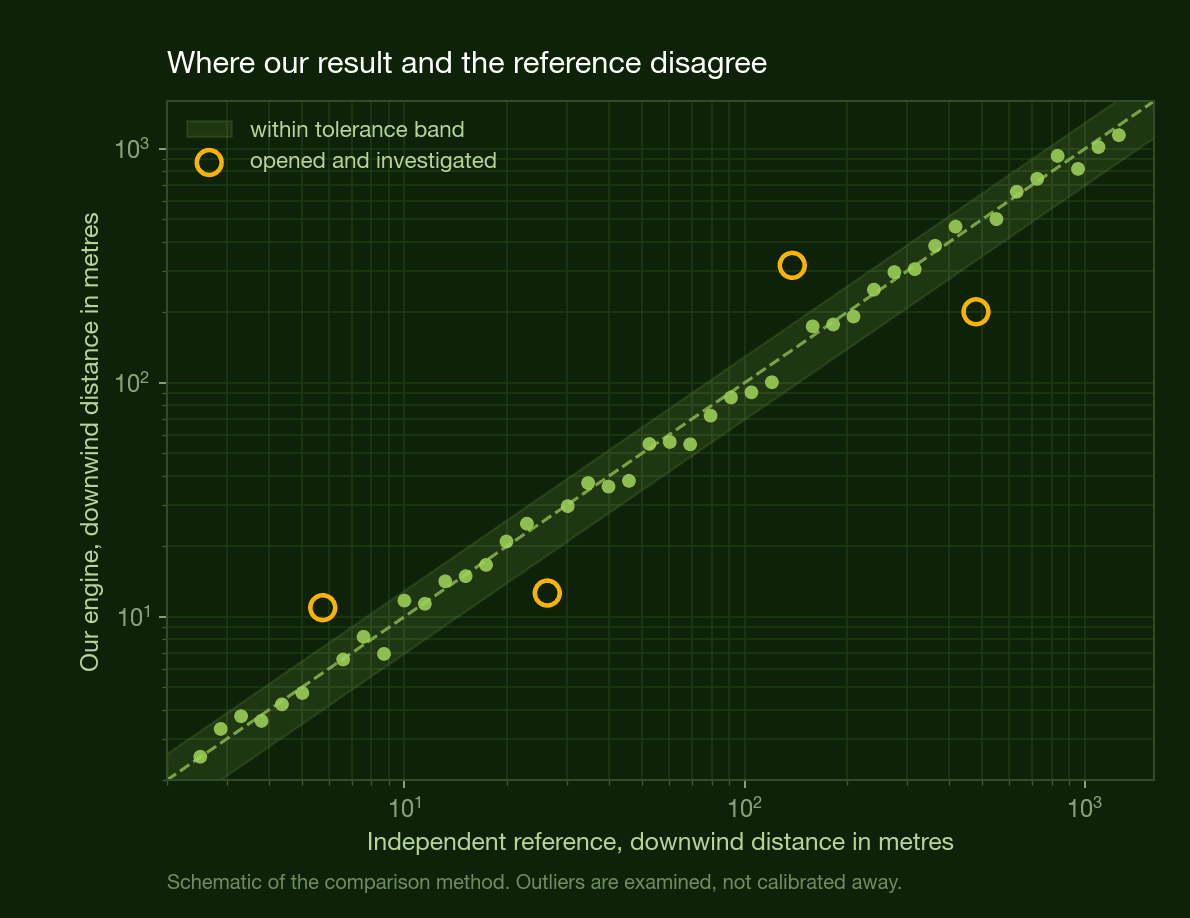
The engine is validated against an independent industry reference across a corpus of completed assessments carrying real inventories, real layouts and real weather sets. Textbook verification cases confirm the arithmetic. They do not test whether a model behaves on a plant.
Where our result and the reference diverge beyond tolerance, the case is opened and the physics examined. Sometimes the reference is closer to reality, sometimes we are, and sometimes both models are outside their stated range. The case is closed only once the cause of the divergence is understood.
Substances and regimes where standard correlations are known to be weak are documented and shipped with the engine, including reactive monomers and several strongly non ideal materials. An engineer who knows where a model is weak can allow for it in the assessment.
AQRA is a screening to assessment grade engine for the release, dispersion, consequence and risk chain. It is not a computational fluid dynamics package, and where a problem genuinely needs resolved three dimensional flow we will tell you so rather than stretch a correlation to cover it.
We will come back with the scope, the timeline and what the licence and training would cost. Tell us the release cases you need assessed and the site the contours have to land on.