Local Exhaust Ventilation (LEV) Design and Validation
LEV design, commissioning, and periodic validation aligned with ACGIH guidance
Local Exhaust Ventilation (LEV)
Design and Validation
Local exhaust ventilation is the highest tier engineering control for airborne contaminants, capturing dust, fume, vapour, or mist at the source before it reaches the breathing zone, yet a large share of installed systems quietly underperform, because capture velocity falls away rapidly with distance and a hood that looks adequate may draw almost nothing where the contaminant is actually generated. Effective LEV is engineered as a system rather than bolted on. Hood geometry and capture velocity are matched to the source and the worker's position, duct sizing delivers a transport velocity that prevents settling, the fan is selected against the true system curve, and the discharge does not re entrain. Our team designs and validates to the ACGIH Industrial Ventilation manual, HSE HSG 258, and ISO 16453, and we verify performance through commissioning and periodic thorough examination and test, because an LEV system is only a control for as long as it is proven to capture.

Our implementation model
We fix the standards that apply to your site before we open at lev design brief & contaminant profile, and we do not close at lev commissioning & validation until they are met.
Define LEV design brief, contaminant profile (gas, vapour, particulate, fume, mist), generation rate per ACGIH Industrial Ventilation Manual, design intent per EN 689 / EN 14175 (fume hood), align with HSE HSG 258 / HSG 37.
Design hood per ACGIH IV / HSE HSG 258, capture hood (slot, panel, enclosure), required capture velocity per contaminant generation, hood static pressure (HSP) target, align with VS schematics from ACGIH Industrial Ventilation.
Design duct per ACGIH IV, transport velocity per material (1000 to 1400 fpm for vapour, 2500 to 3500 fpm for fine dust, 4000 to 4500 fpm for fibrous), duct material selection per contaminant, specify duct sizing and pressure loss calculation.
Specify air cleaner per contaminant, baghouse / cartridge (particulate), wet scrubber (acid gases), activated carbon (VOC), HEPA (high efficiency particulate), thermal oxidiser (combustible VOC), align with EPA emission standards.
Select fan per system curve and operating point, centrifugal (forward curved, backward inclined, radial, airfoil), axial, specify motor (premium efficiency per IE3 / IE4), VFD (variable frequency drive) for energy optimisation, align with AMCA.
Validate per HSE HSG 258 / EN 14175 / ANSI Z9.5, face velocity (typically 80 to 100 fpm fume hood, capture velocity per design), static pressure verification, smoke testing, tracer gas testing, conduct annual thorough examination / test.
Local Exhaust Ventilation (LEV) in full scope
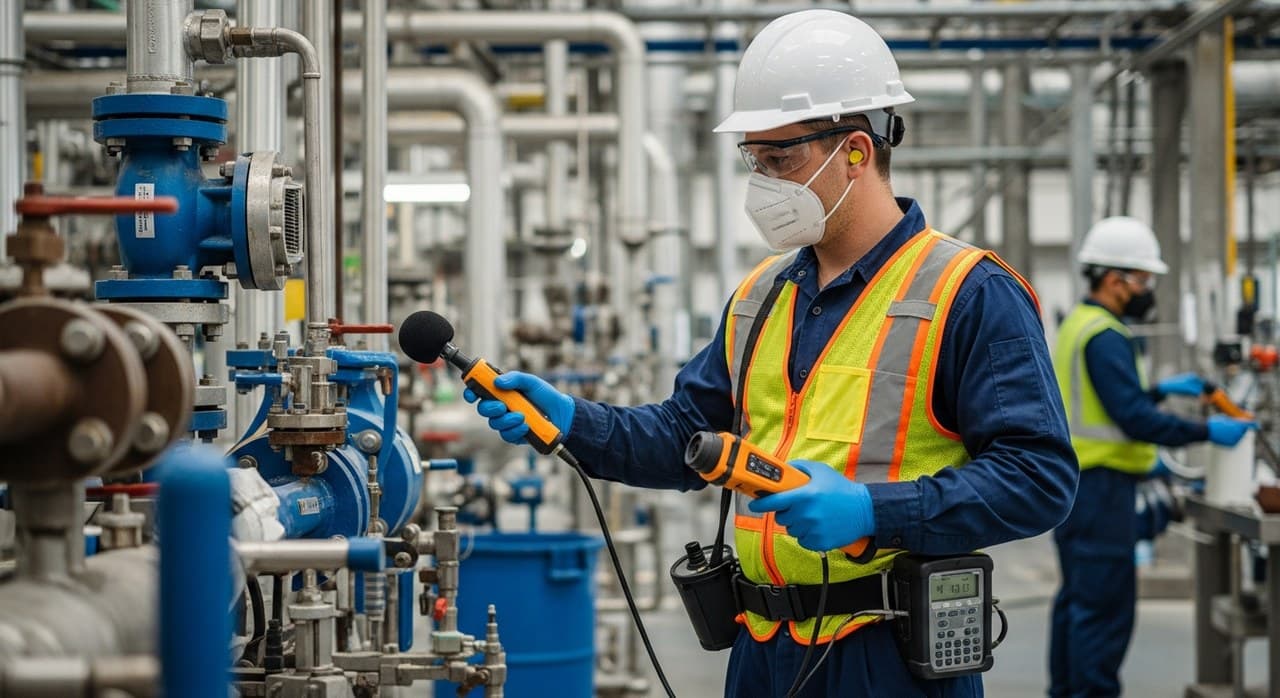
Value of Local Exhaust Ventilation (LEV) Design and Validation
- Captures contaminants at the source
- Reduces breathing zone exposure
- Strengthens chemical containment
- Supports emergency ventilation
- Stays compliant with ACGIH and HSE LEV guidance
- Documents the control required under COSHH and its equivalents
- Supports the OSHA HazCom hierarchy
- Withstands a thorough examination and test audit
- Reduces nuisance odour and complaints
- Protects product quality by preventing cross contamination
- Improves operator comfort
- Supports realistic capture in operation
- Sizes the LEV capacity and energy correctly
- Avoids over specified ductwork
- Reduces reliance on PPE
- Improves HVAC energy efficiency
Codes & standards we work to
Triggers that signal the need
Where Local Exhaust Ventilation (LEV) Design and Validation applies
Tangible deliverables
- An LEV design basis
- Hood and duct drawings
- Fan and filter specifications
- A commissioning test procedure
- A thorough examination and test report and certificate
- An operating and maintenance manual
Send us the scope
We will scope Local Exhaust Ventilation (LEV) Design and Validation against your site and come back with what it would take. Tell us the site, the consents it holds and what it is measured against.