Industrial Hygiene
We measure and control the exposures your workforce cannot see, assessing chemical, physical, biological and ergonomic stressors and then engineering the controls that bring them within safe limits, so that long term health is protected across every shift and every role on your site.
Why industrial hygiene matters
Industrial Hygiene quantifies and controls the chemical, physical, biological and ergonomic exposures that drive occupational disease. Our team operates to the AIHA, NIOSH and EN 689 sampling strategy, the ACGIH TLV and OSHA PEL benchmarks, the Factories Act 1948 Indian OEL frame and the DGFASLI and NIOH guidance that defines the Indian industrial hygiene baseline. The work spans exposure monitoring with AIHA LAP accredited laboratories, noise mapping per ISO 9612, indoor air quality per ASHRAE 62.1, local exhaust ventilation design per HSE HSG 258, thermal stress per ISO 7933 and full PPE programme design.
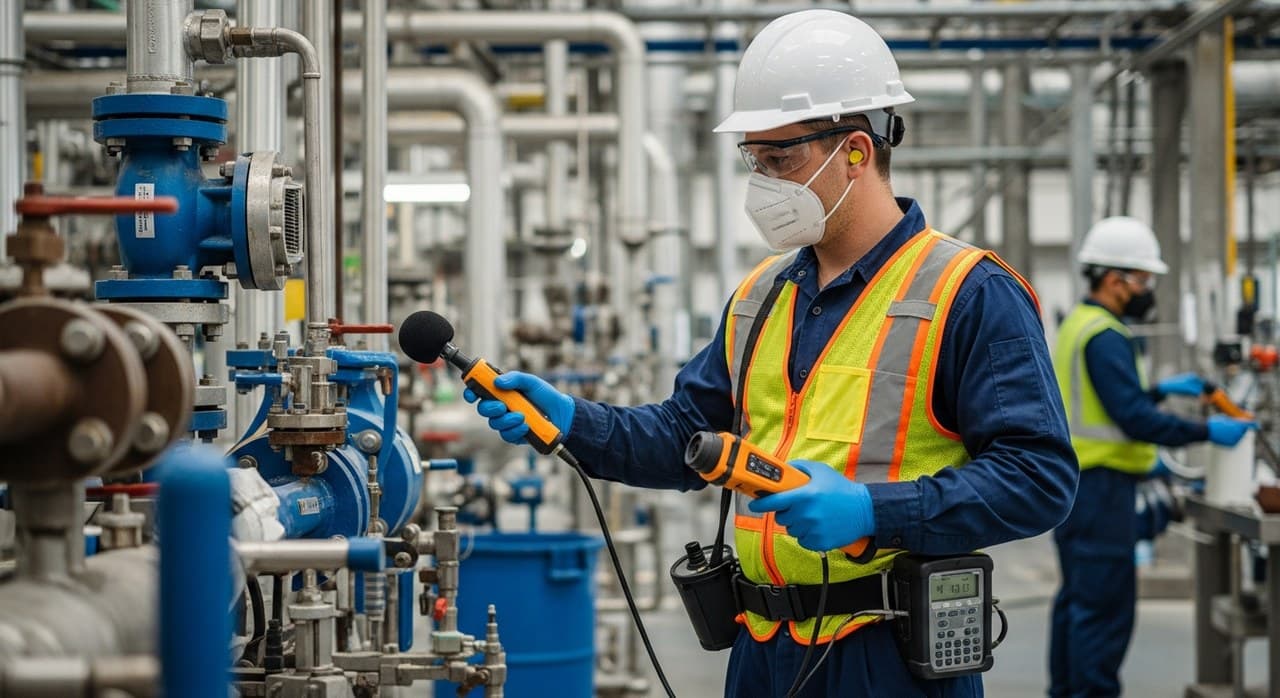
Industrial Hygiene capabilities
How we deliver
A phased, evidence led delivery model that runs from discovery through close out and is built around your facility, regulatory context, and lifecycle stage.
What this service delivers
- Defensible exposure data that holds up under regulator and litigation review
- OEL exceedance closed through the engineering, administrative and PPE control hierarchy
- A noise programme that reduces standard threshold shifts and the audiometric loss recordable rate
- Local exhaust ventilation systems commissioned to the actual capture velocity rather than the promised one
- A health surveillance evidence pack that closes occupational disease cases
Our differentiators
- AIHA LAP and ISO IEC 17025 accredited laboratory partnerships
- Field measurement with Type 1 sound instruments, MIE pumps and real time monitors
- Statistical interpretation per the AIHA strategy rather than single sample reports
- Factories Act and DGFASLI India fluency with an ACGIH and NIOSH overlay
Related services
We build environmental management systems that fit how your site actually operates, covering environmental impact assessment, air quality, water and waste compliance, so that your facility meets its statutory obligations and earns the trust of regulators and the community around it.
We help you protect the people who keep your plant running through practical workplace safety systems, from risk assessment and behaviour based safety to ergonomics and worker health surveillance, so that safe working becomes a shared habit rather than a poster on the wall.
We help you carry chemical regulatory responsibility across every market you sell into, authoring safety data sheets, handling GHS classification and REACH compliance and managing the full lifecycle of your products, so that your goods reach customers worldwide with the right information and clear regulatory standing.
Standards we work to
Industries we serve
- Chemicals and Petrochemicals
- Pharmaceuticals and API
- Foundries, Metal Works and Smelters
- Mining, Cement and Aggregates
- Textile and Tannery
- Construction and Shipyards
Frequently asked questions
What is industrial hygiene?
Industrial hygiene quantifies and controls the chemical, physical, biological and ergonomic exposures that drive occupational disease. We measure the exposures your workforce cannot see, assess them against occupational exposure limits and then engineer the controls that bring them within safe limits, so long term health is protected across every shift and every role on your site.
Which sampling strategies and standards do you follow?
We work to the AIHA Exposure Assessment Strategy and the NIOSH sampling manual with EN 689 statistical interpretation, benchmarking against ACGIH TLVs, OSHA PELs and the Factories Act 1948 Indian OELs. Noise mapping follows ISO 9612, thermal stress follows ISO 7933, indoor air quality follows ASHRAE 62.1 and local exhaust ventilation follows HSE HSG 258. Laboratory analysis runs through AIHA LAP and ISO IEC 17025 accredited partners.
When should exposure monitoring be carried out?
You should monitor when workers handle chemicals, dusts or solvents, when noise, heat or illumination may exceed limits, when a health surveillance programme flags a possible exposure, or when a regulator or litigation requires defensible exposure data. Because exposures vary shift to shift, a statistically designed campaign across similar exposure groups gives a far more defensible picture than a single spot sample.
What do you deliver?
You receive defensible exposure data interpreted statistically against the relevant OEL, a control hierarchy that closes any exceedance through engineering, administrative and PPE measures, a noise programme that reduces standard threshold shifts, local exhaust ventilation validated to the actual capture velocity, and a health surveillance evidence pack. The work integrates engineering controls such as local exhaust ventilation with PPE specified to OSHA 1910.134 and EN 529.
Which industries need industrial hygiene support?
It applies to chemicals and petrochemicals, pharmaceuticals and API, foundries, metal works and smelters, mining, cement and aggregates, textile and tannery, and construction and shipyards. We combine Factories Act and DGFASLI India fluency with an ACGIH and NIOSH overlay.
Talk to us about industrial hygiene.
We will come back with the scope, the standards it would be run to and what it would take. Tell us which part of industrial hygiene you need and the site it applies to.