Hazardous area classification decides where an explosive atmosphere can exist around a plant, how often, and for how long. That answer sets which equipment may be installed in each location and how it must be protected, so it is one of the few studies whose output is built into the plant rather than filed beside it. A zone drawing that is wrong in one direction puts an ignition source where gas collects. Wrong in the other direction, it puts flameproof equipment, cable glands and inspection obligations across areas that never needed them.
This page treats a classification as what it really is, a chain of linked records. Each zone should trace back to a release source, a release rate and a judgement about ventilation, and forward to the equipment installed inside it. Most classifications that fail in practice fail at a break in that chain, so the page is organised around the chain.
What a classification delivers
Before the method, the outputs. A classification that produces less than this has usually drawn zones without recording why.
- A schedule of release sources, each with its location, the fluid, the operating conditions and the grade of release assigned to it
- The release rate and dilution assessment behind each source, or the code approach used instead and the reason it applies
- A ventilation record stating the type, degree of dilution and availability assumed for each area, with the basis for each assumption
- Zone drawings in plan and elevation, since heavier than air vapours and lighter than air gases do not spread in the same direction
- For each classified area, the gas group and temperature class the equipment must meet, along with the required equipment protection level
- A reconciliation against the Ex equipment register, so every item installed in a classified area is shown to meet its zone
- The assumptions that, if they change, require the classification to be revisited
Start from the release, not from the plot plan
The classification starts with a list of places where flammable material can escape. These include pump and compressor seals, flanges, valve stems, sample points, drains, vents, relief valve outlets, open process vessels and loading connections. Each one is a source of release. The zones are drawn around them, so a source that is missed is an area that stays unclassified however careful the rest of the study is.
Each source is then graded by how often it releases. A continuous grade release is present continuously or for long periods, such as the vapour space above a liquid in a fixed roof tank vented to atmosphere. A primary grade release can be expected periodically or occasionally in normal operation, such as a sample point that is opened on every shift. A secondary grade release is not expected in normal operation and, if it happens, is infrequent and brief, such as a flange gasket that fails.
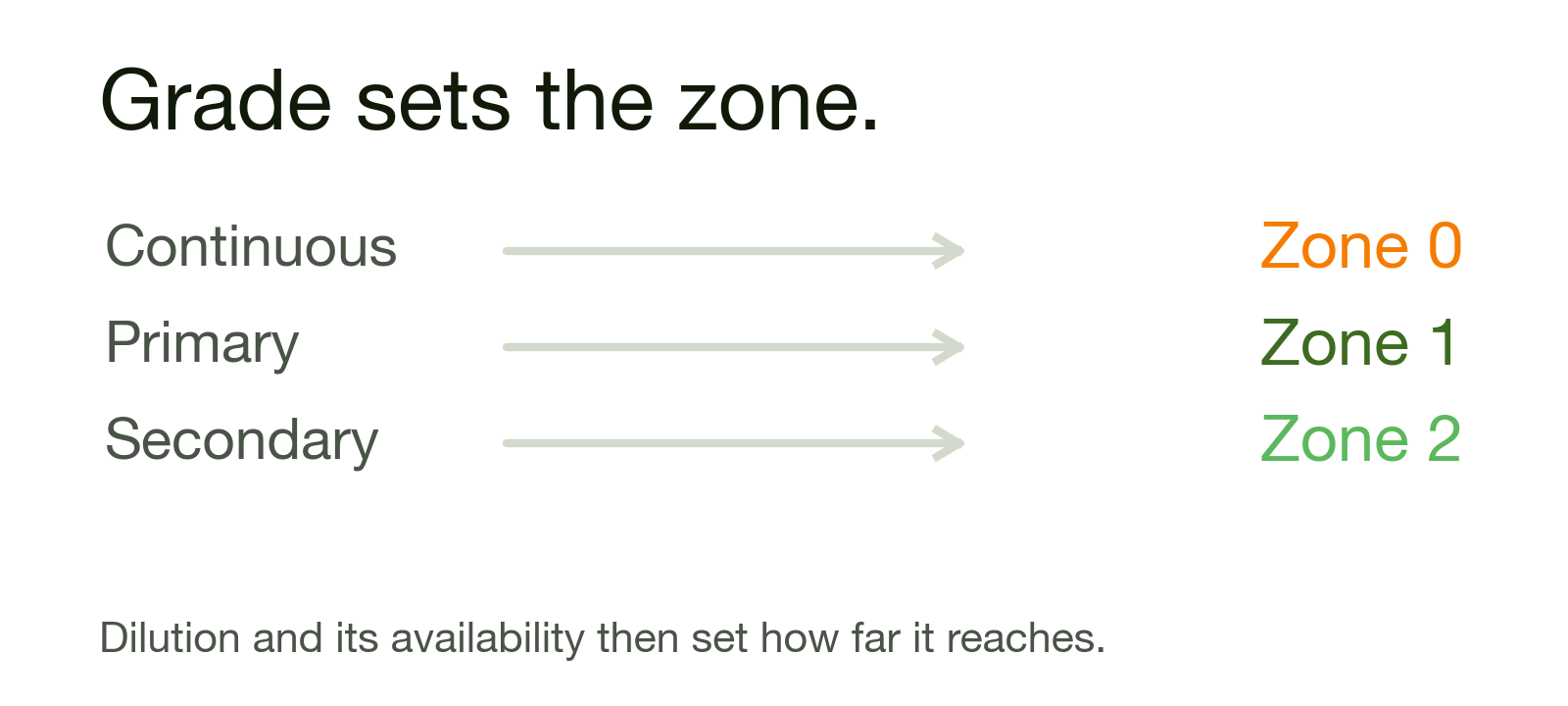
In most cases, the grade decides the type of zone. A continuous release tends to produce Zone 0, a primary release Zone 1 and a secondary release Zone 2. The mapping is not automatic, however. Poor ventilation can make a zone more severe than its grade suggests, and strong dilution can shrink a zone until its extent is negligible. That is the next step.
Release rate and dilution
IEC 60079-10-1 asks for a release rate for each source, which depends on the fluid, its phase, the pressure and temperature driving it, and the size of the opening. For secondary grade releases the opening is a hole size that represents a credible failure of the item, and the standard offers guidance on typical values by item. That choice is a judgement, and the classification should record it.
The release rate is then set against the ventilation available to dilute it. The standard compares the two using a characteristic volumetric release rate, which expresses how much air is needed to take the release below its lower flammable limit.
- characteristic volumetric release rate, m³/s
- mass release rate of flammable gas or vapour, kg/s
- density of the released gas or vapour at ambient conditions, kg/m³
- safety factor applied to the lower flammable limit
- lower flammable limit, as a volume fraction
The degree of dilution comes out as high, medium or low. High dilution disperses a release almost at the source. Medium dilution holds the zone to a limited extent, and low dilution means the release is not controlled by the ventilation and the explosive atmosphere persists. The same standard then asks how dependable that ventilation is, rating its availability as good, fair or poor. A fan that stops on a power failure does not deliver the dilution it was credited with while the plant is still releasing.
Together, these two judgements are the core of the classification. A high degree of dilution with good availability can reduce a zone to negligible extent, which is how an open, well ventilated area around a secondary grade source can legitimately be treated as non hazardous. A low degree of dilution in a pit, trench or enclosed analyser house can turn a secondary grade source into a Zone 1, because heavy vapour has nowhere to go.
Natural ventilation outdoors is often credited without examining the layout. Congested modules, walls, dike enclosures and ground depressions all reduce the air movement actually available, and they are where heavier than air vapours collect.
Calculation or code
Not every source needs a calculation. Industry codes offer pre-assessed extents for common equipment in defined circumstances. For petroleum facilities, EI 15 gives a point source approach with hazard radii set by the fluid category and release pressure. In the United States, API RP 505 and API RP 500 serve the same purpose under zone and division schemes, and NFPA 497 covers chemical process areas.
These codes are valid when the facility matches the conditions they assume, and weak when it does not. A code extent that fits a hydrocarbon pump at moderate pressure outdoors does not transfer to the same pump in an enclosed shelter, to a hydrogen service or to a release at much higher pressure. A classification may use a code for most sources and calculate the rest, which is often the most efficient approach. What it should not do is apply a code extent without recording why the code's assumptions hold at that location.
What the zones mean for equipment
The zone decides the equipment protection level required. IEC 60079-14 matches Zone 0 to equipment protection level Ga, Zone 1 to Gb and Zone 2 to Gc, with the dust equivalents Da, Db and Dc for Zones 20, 21 and 22. Protection concepts are then chosen to meet that level: flameproof enclosures, increased safety, intrinsic safety, pressurisation, encapsulation and others. Each concept has its own installation and inspection requirements.
The zone alone does not fully specify the equipment. Two properties of the gas matter as well. The gas group, IIA, IIB or IIC, reflects how easily a flame passes through a gap and how little energy ignites the mixture, and IIC covers the most demanding gases such as hydrogen and acetylene. The temperature class limits how hot any surface of the equipment may become, and it must sit below the autoignition temperature of the gas.
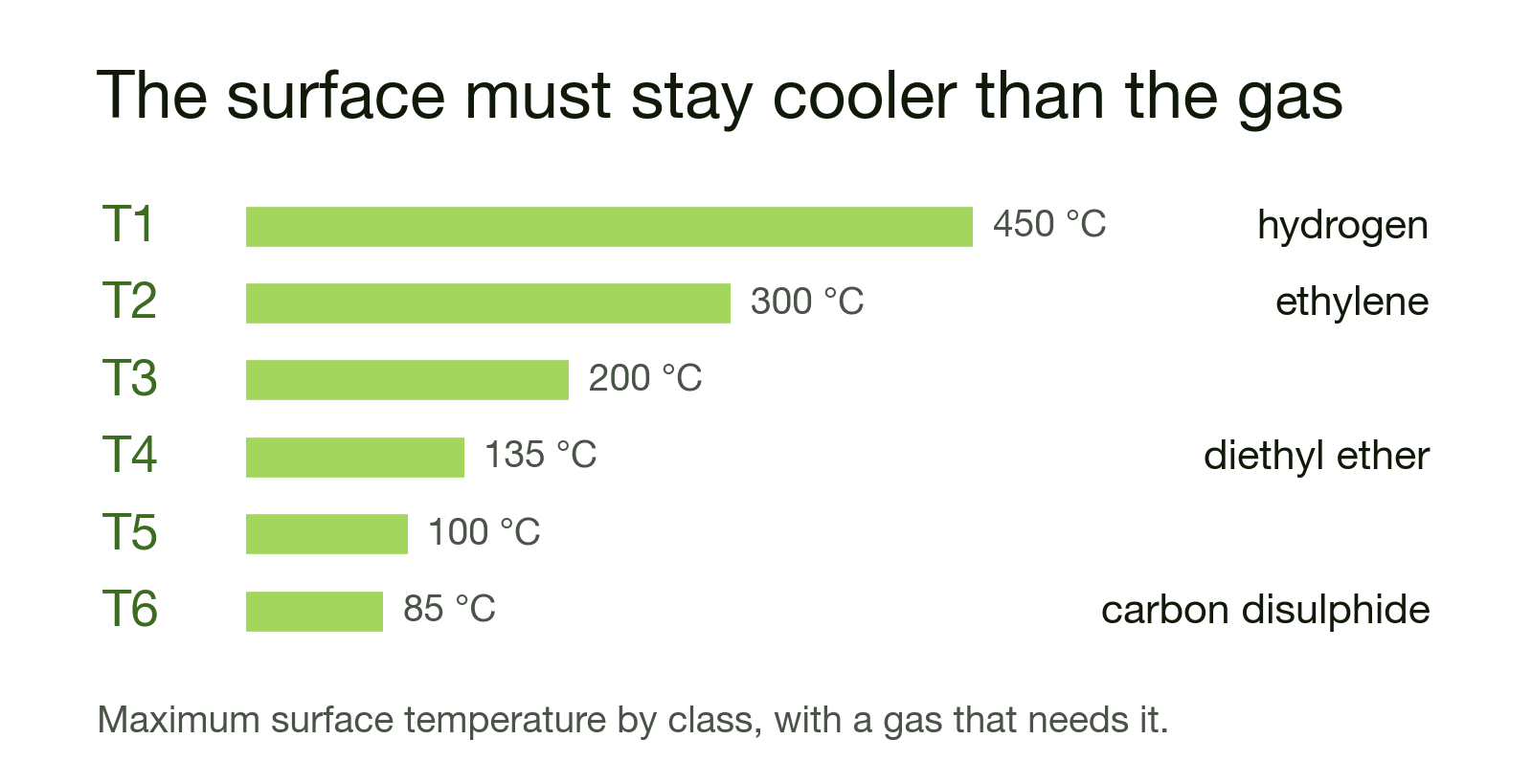
This is why a classification must carry the gas group and temperature class for every area, not just the zone. A zone drawing that says Zone 1 and nothing else leaves the equipment choice to whoever specifies each item, and the most restrictive fluid in a shared area is easy to overlook when the data sheet only mentions the main process stream.
Ignition sources that are not electrical
Hazardous area classification is often treated as an electrical deliverable, and the zone drawing is usually filed with the electrical design. The zones, however, govern every ignition source. Hot surfaces on pumps, gearboxes and uninsulated steam lines, sparks from mechanical contact, and static discharge from flowing liquids and powders all ignite an explosive atmosphere just as electrical equipment does. ISO 80079-36 and ISO 80079-37 cover non-electrical equipment for explosive atmospheres, and EN 1127-1 sets out the full range of ignition sources to consider.
A classification that has only been checked against the electrical equipment list is incomplete. The mechanical equipment list, the static control arrangements and the hot work controls for the area all rely on the same zones.
Dust
Combustible dust is classified under IEC 60079-10-2 into Zones 20, 21 and 22, mirroring the gas zones. It needs its own assessment rather than an adaptation of the gas one. A dust cloud behaves differently from a gas release, and a dust layer adds a problem gas never has: a layer on a hot surface can smoulder and ignite at a temperature well below that of a cloud of the same material. Housekeeping is therefore part of the classification basis. A Zone 22 that assumes layers are removed at a set frequency is only valid while that cleaning happens.
Where the chain breaks
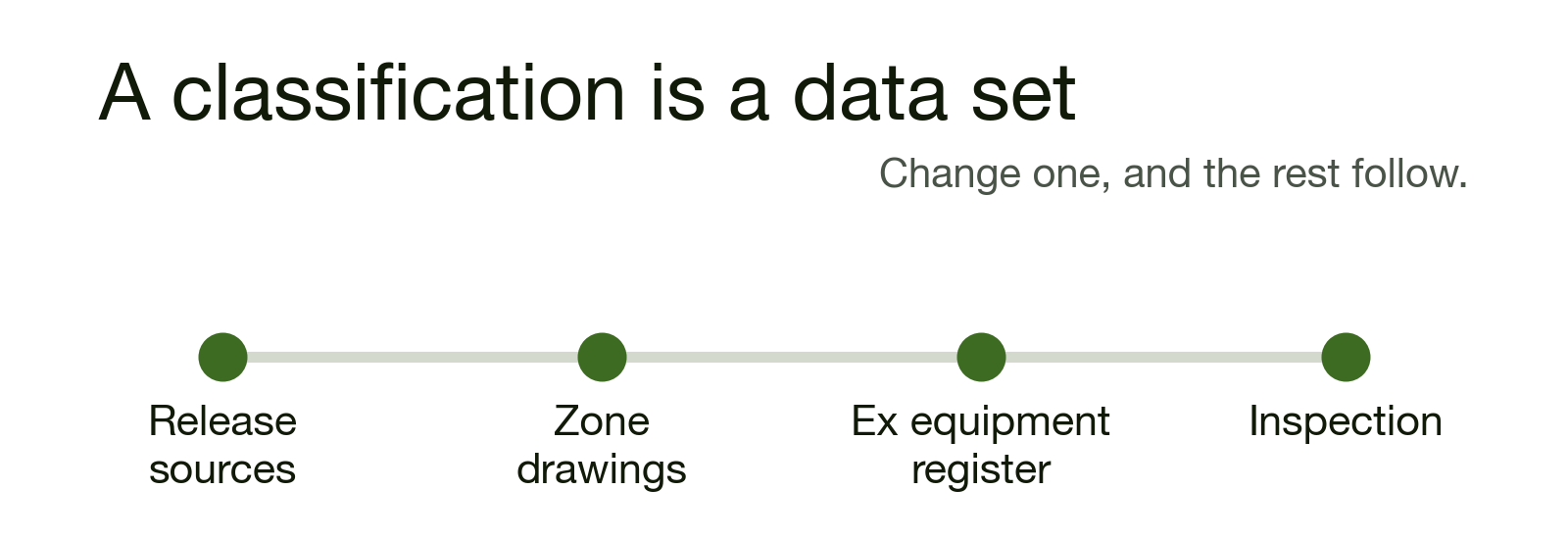
The failures seen most often in practice are not calculation errors. They are breaks between the linked records.
- Zones copied from a similar plant, keeping the extents but not the fluid, pressure or ventilation that produced them
- Blanket Zone 1 applied to a whole unit as a precaution. This is not conservative. It spreads Ex equipment and inspection effort thinly across areas that do not need them, and hides the locations that do
- Good ventilation assumed rather than assessed, particularly in shelters, analyser houses, pits and trenches
- A gas group and temperature class taken from the main process fluid while a more demanding fluid is present in the same area
- Non-electrical equipment left out of the assessment entirely
- New flanges, sample points, drains or vents added under a change without the classification being reopened
- An Ex equipment register that cannot be reconciled with the zone drawings, so nobody can show that a given item meets its zone
- Temporary equipment brought in for a turnaround or project with no check against the zones it will stand in
Each of these can leave a classification drawing that looks complete while the plant it describes has moved on. The drawing should carry a revision history tied to the changes that altered it, and the change process should ask whether a proposed modification adds, moves or alters a release source.
From classification to inspection
The classification is where explosion protection starts, not where it ends. Equipment is installed to IEC 60079-14, inspected to IEC 60079-17 and repaired or overhauled to IEC 60079-19. Each of those standards depends on the zone, gas group and temperature class that the classification assigned. An inspection programme that cannot say which zone an item sits in cannot set its inspection grade or interval, and an item repaired without reference to its certification can lose the protection it was installed for.
Legal duties in this area differ from one jurisdiction to another. In the European Union, equipment for explosive atmospheres falls under Directive 2014/34/EU and workplace duties under Directive 1999/92/EC, while in the United Kingdom the workplace duties sit in DSEAR. In the United States the National Electrical Code sets out the zone and division schemes. In India, OISD-STD-113 applies to hydrocarbon processing and handling facilities. A classification should state which of these it has been prepared against, because the standard of care for the work depends on it.
IEC 60079-10-1 covers explosive gas atmospheres and IEC 60079-10-2 covers combustible dust. IEC 60079-14, 60079-17 and 60079-19 cover installation, inspection and repair. Industry codes such as EI 15, API RP 505, API RP 500 and NFPA 497 provide pre-assessed extents where their assumptions hold.
When to revisit a classification
A classification needs to be revisited when a release source is added, moved or changed, when the fluid or its operating conditions change, when ventilation is altered or a structure is added that restricts it, and when equipment arrives that was not considered in the original assessment. It should also be reviewed after any incident or near miss involving a release in or near a classified area. A fixed review interval is a sensible backstop, but most classifications become outdated through change rather than time.
Arborion prepares hazardous area classifications from the release source up, with the calculations, ventilation assumptions and equipment reconciliation recorded alongside the drawings. We also inspect existing installations against the classification they were built to. If you have a classification that has not been reopened since the plant last changed, or zone drawings that nobody can trace back to a release, send us the drawings and the process data and we will tell you what the classification rests on and where it no longer holds.