Carbon accounting stopped being a voluntary disclosure exercise for Indian industry this year. Compliance obligations under the Carbon Credit Trading Scheme came into force for the 2025-26 financial year across the energy intensive sectors, and the first verified emissions reports fell due at the end of July 2026. A greenhouse gas number that used to sit in a sustainability report now sits against a notified emission intensity target, gets checked by an accredited verification agency, and carries a financial consequence. ISO 14064 is the standard that decides whether that number holds together.
Most of the difficulty is not in the arithmetic. It is in the decisions taken before any arithmetic happens, and in a handful of places where the reported figure moves for reasons that have nothing to do with the plant. This article walks the standard the way an inventory is actually built, and marks the points where we have seen a figure fail to survive a verifier reading it.
What ISO 14064 actually covers
ISO 14064 is three separate documents that get referred to as one standard, and they answer three different questions. Confusing them is the first thing that goes wrong in a tender document.
- Part 1 is the organisation level inventory. It sets how you draw the boundary, which emissions you must quantify, and what the report has to contain.
- Part 2 is the project level standard. It applies to a specific intervention that claims a reduction or a removal enhancement against a baseline, which is the shape of a carbon credit.
- Part 3 is validation and verification. It is what a third party works to when it forms an opinion on your greenhouse gas statement.
- ISO 14065 sits alongside it and sets the requirements for the body doing that verification, and ISO 14066 covers the competence of the team it fields.
ISO 14064-1:2018, ISO 14064-2:2019 and ISO 14064-3:2019, with ISO 14065:2020 for the verification body. The 2018 revision of Part 1 changed the reporting structure materially, so a procedure written against the 2006 edition is not compliant simply because the number in the title matches.

Scopes are not categories, and the difference is not cosmetic
If your organisation already reports to the GHG Protocol, you report Scope 1, Scope 2 and fifteen Scope 3 categories. ISO 14064-1:2018 does not use scopes. It requires direct emissions and removals, then indirect emissions sorted into five further categories. The two structures overlap heavily and map onto each other nowhere exactly, so a scope subtotal cannot be relabelled and carried across.
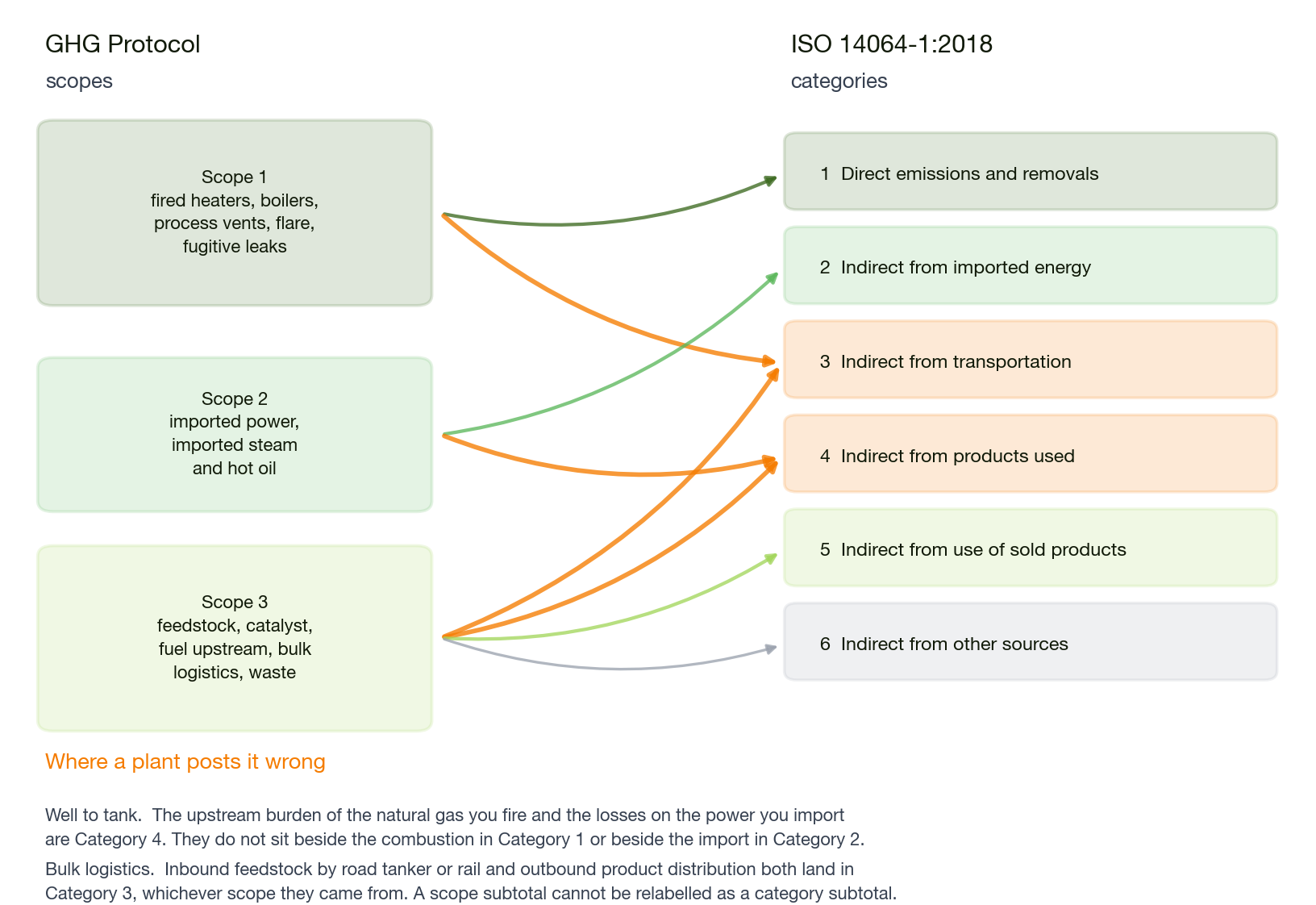
Two places catch process plants in particular. The first is well to tank. The upstream burden of the natural gas you fire and the transmission losses on the power you import are Category 4, indirect emissions from products used by the organisation. They do not belong beside the combustion in Category 1 or beside the import in Category 2, and a plant that has only ever reported Scope 1 and Scope 2 usually has not quantified them at all. The second is bulk logistics. Inbound feedstock by road tanker or rail and outbound product distribution both land in Category 3 whichever scope they arrived from, so the transport figure has to be rebuilt rather than moved.
The boundary is the first decision and the hardest one to undo
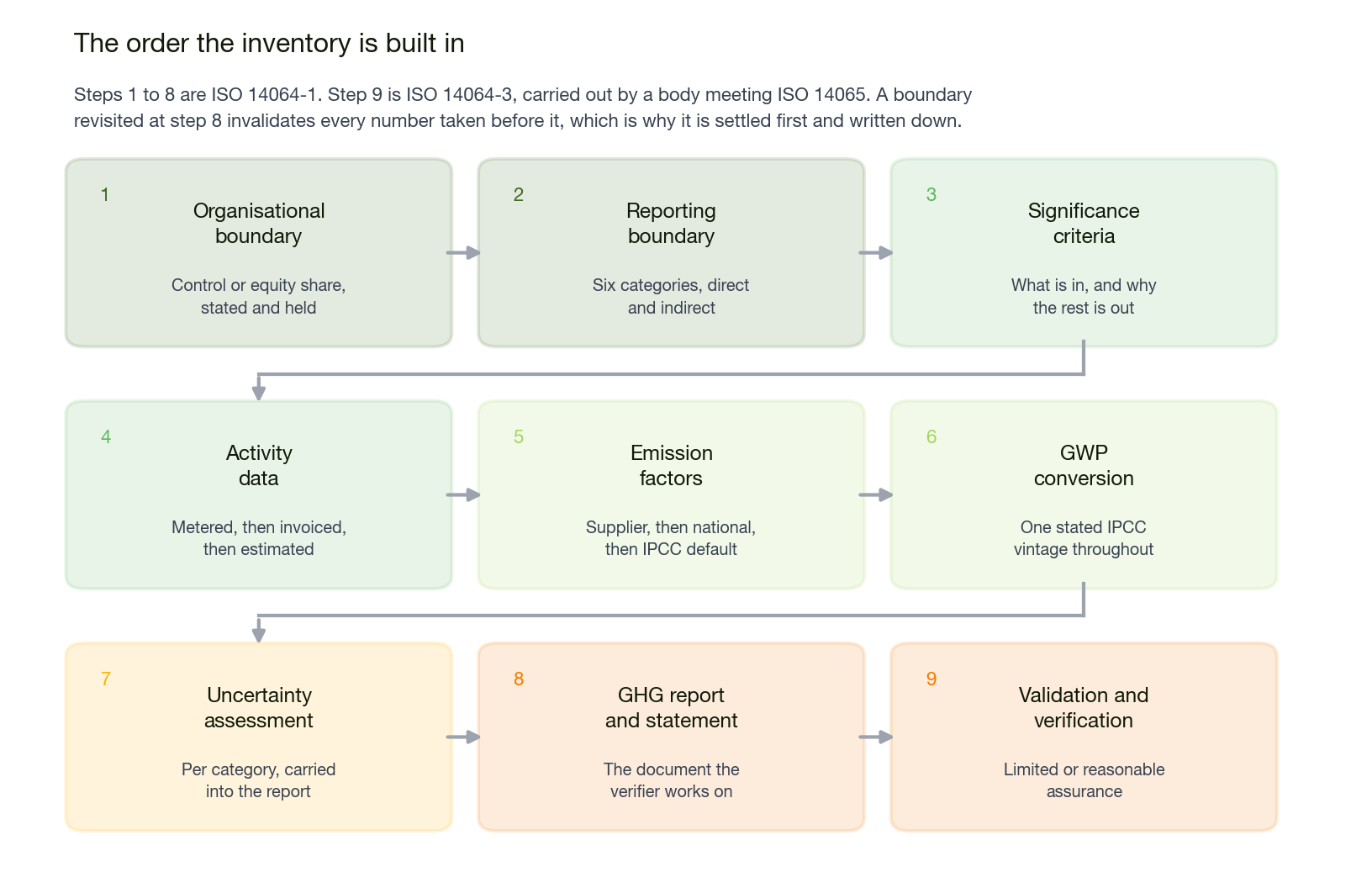
Before any emission is counted, two boundaries are set. The organisational boundary decides which facilities belong to the reporting entity, using either a control approach or an equity share approach. The reporting boundary decides which categories of emission are quantified within it. Both have to be stated, applied consistently, and held from year to year, because a boundary revisited late invalidates every number taken before it.
The consolidation choice is where a group structure bites. A joint venture plant where you hold a minority stake but operate the site is fully inside an operational control boundary and only partly inside an equity share boundary. A tolling arrangement, a leased tank farm and a captive power plant owned by a related company each need the decision written down rather than assumed. The questions worth settling before the first data request goes out are these.
- Which consolidation approach applies, and is the same one used in the financial statements
- How joint ventures, tolling arrangements and leased assets are treated, entity by entity
- Whether a captive power plant is inside Category 1 as direct combustion or outside it as an imported energy purchase
- What the base year is, and what change in structure or method triggers a recalculation of it
Significance, and the exclusions you have to write down
ISO 14064-1:2018 does not ask you to quantify every indirect emission in existence. It asks you to establish criteria for what counts as significant, apply them, and then justify in writing what you left out. The second half is the part that gets skipped. An inventory that quietly omits a category is not the same document as one that names the category, states the criterion it failed, and shows the order of magnitude estimate behind that judgement.
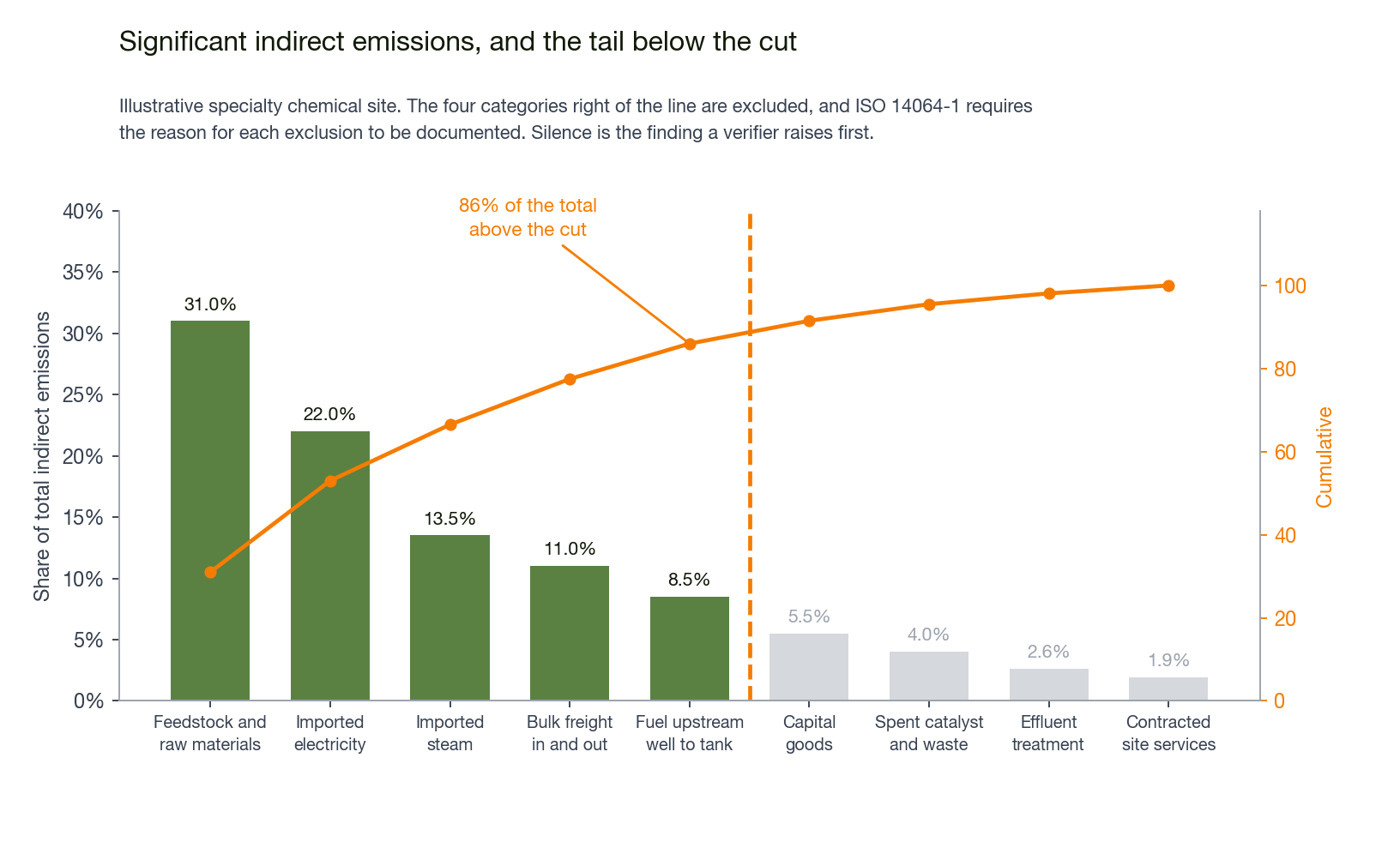
Reasonable criteria combine magnitude, influence and data availability. Magnitude is the obvious one. Influence matters because a category you can actually change belongs in the inventory even when it is small, and a category you cannot influence at all is worth naming for that reason. Data availability is legitimate as a criterion but not as an excuse, and the difference between the two is whether the estimate that established the magnitude exists on paper.
Where the activity data comes from
Every line of the inventory reduces to the same product. Activity data multiplied by an emission factor, converted to carbon dioxide equivalent by a global warming potential.
- activity data for source i, such as fuel fired or electricity imported
- emission factor for that source and gas, mass of gas per unit of activity
- 100 year global warming potential, from a stated IPCC assessment report
The strength of the inventory is the strength of the weakest activity data behind a significant category. There is a hierarchy, and a verifier will work down it.
- Directly measured, from an instrument with a calibration record and a maintained uncertainty statement
- Invoiced or metered by a counterparty, reconciled to your own records
- Derived from a mass or energy balance that closes
- Estimated from a production ratio or a published intensity, with the basis recorded
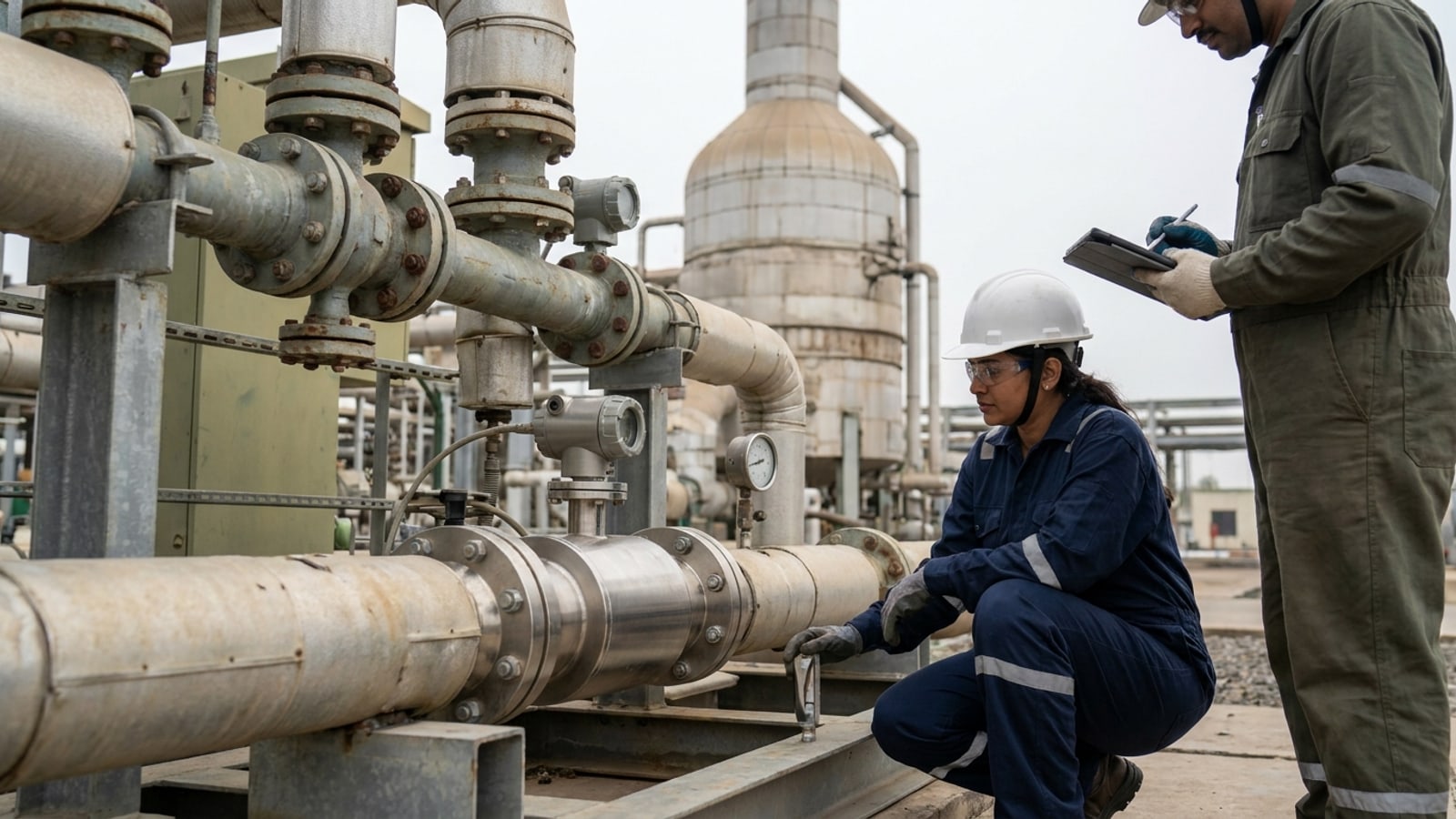
A fuel gas flow meter that has never been proved is the most common single finding on an industrial inventory. It reads plausibly, it feeds a Category 1 total, and it has no calibration certificate behind it. The number is not wrong so much as unsupportable, and unsupportable is what fails a verification.
The emission factor you do not control
For imported electricity in India the factor comes from the CEA CO2 Baseline Database for the Indian Power Sector, which is reissued as the generation mix changes. Version 20.0 carried a weighted average of 0.727 tonnes of carbon dioxide per megawatt hour for 2023-24. Version 21.0 carried 0.7117 for 2024-25. The grid decarbonised. Your plant did not.
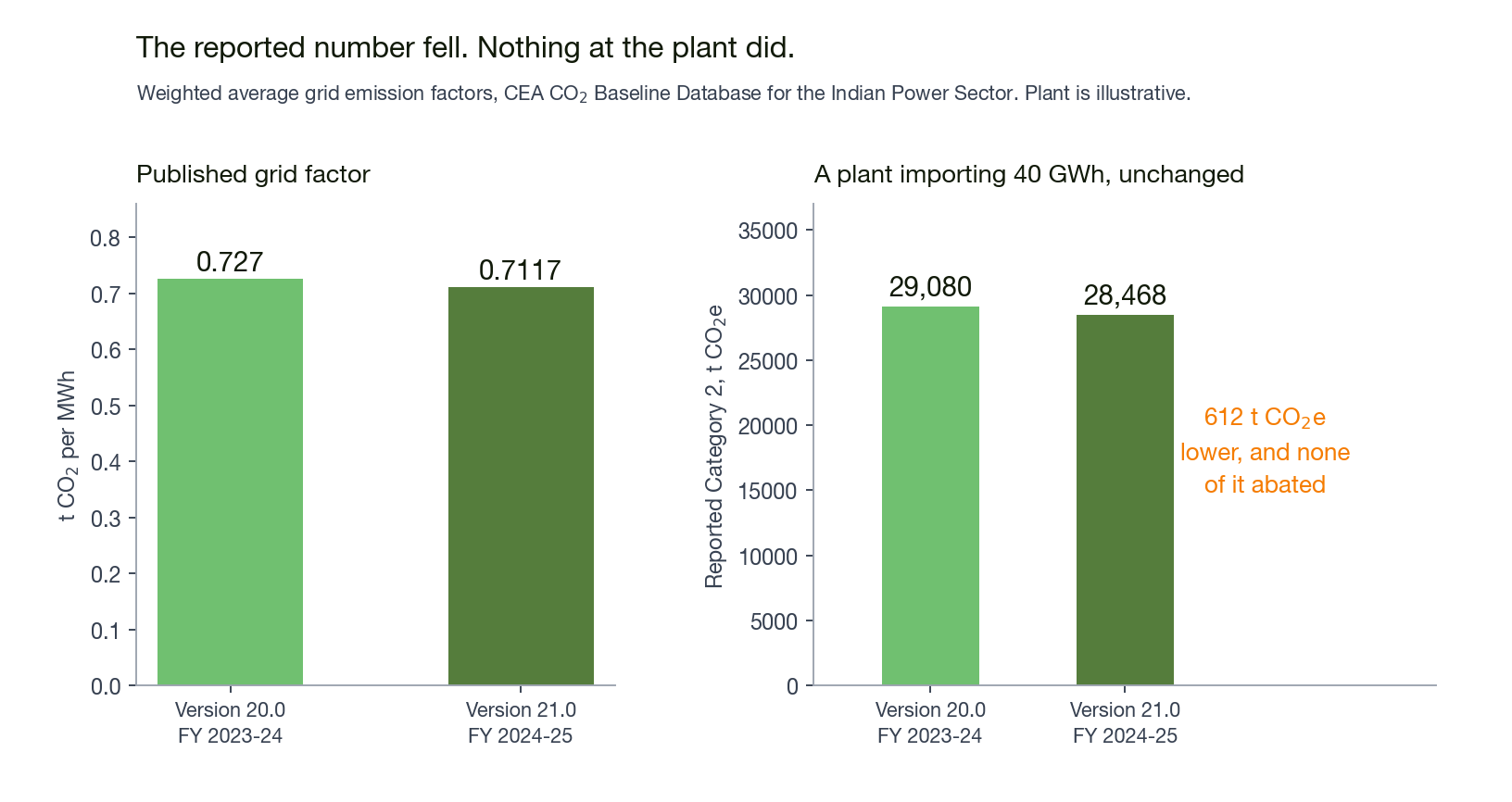
This matters more under an intensity target than under an absolute one. If the obligation is expressed as emissions per tonne of product, a fall in the published grid factor delivers part of the required reduction without any project being executed, and a rise takes it back. Neither movement is a performance result, and an internal report that presents it as one will not survive the first question from a verifier or a board member who reads the footnote. State the factor version used, state it in the same place every year, and separate the factor effect from the physical effect when you report progress.
Your number moves when the IPCC publishes
Global warming potentials are not constants. They are published values that change with each IPCC assessment report, and the direction of the change is not the same for every gas. Methane went up between the fourth assessment report and the sixth. Nitrous oxide went down.
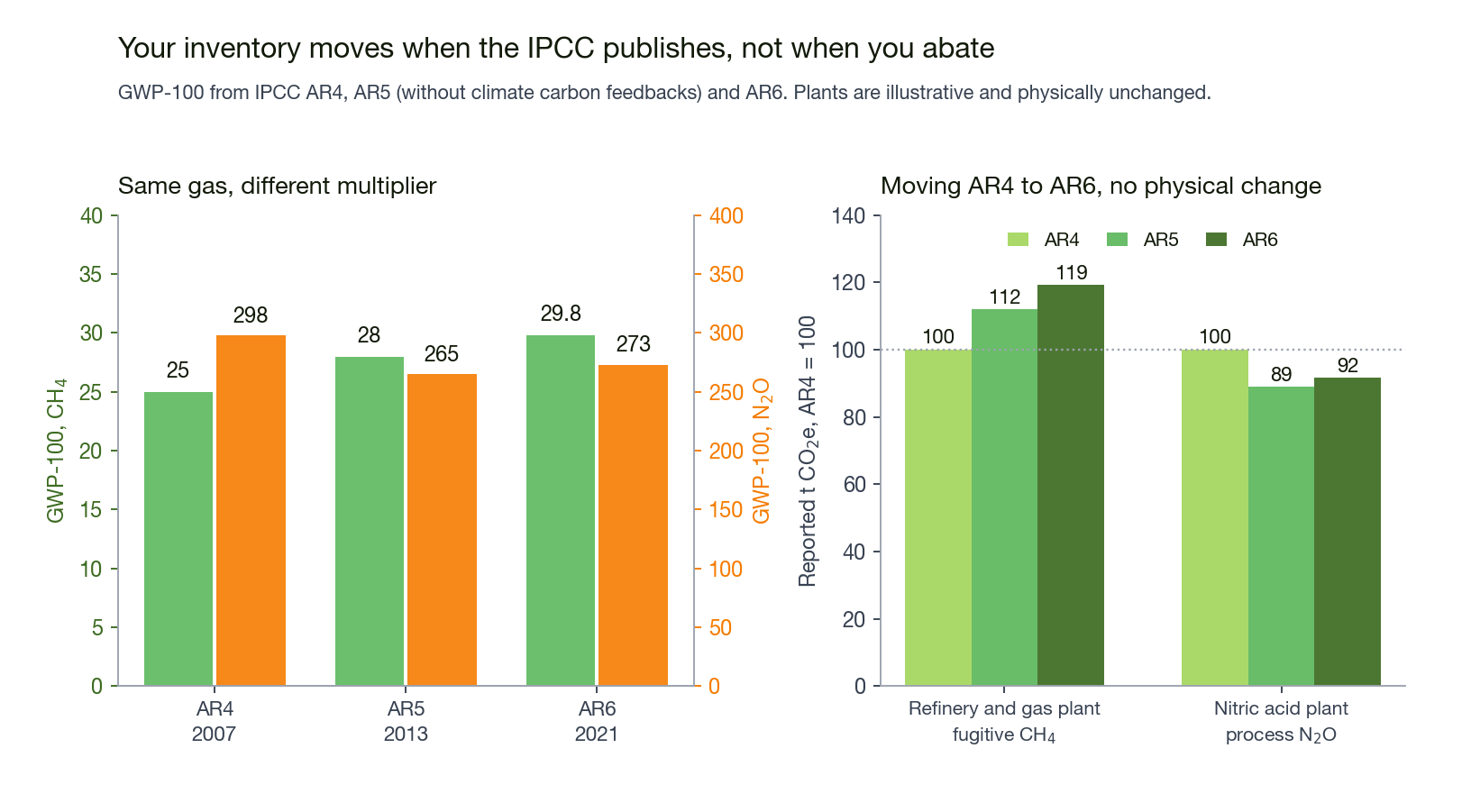
For a refinery or gas processing site where fugitive methane dominates, moving from the fourth assessment report to the sixth raises the reported total by around a fifth. For a nitric acid plant where process nitrous oxide dominates, the same move lowers it by around eight per cent. Neither plant has changed. Which vintage applies is normally set by the programme you are reporting into, so the practical rule is to state it explicitly, apply one vintage across the whole inventory, and never mix vintages between gases or between years.
The base year, and the recalculation almost nobody does
This is where the two effects above turn into a claim that is not true. Take a nitric acid plant that emitted 1,000 tonnes of nitrous oxide in its base year and reported it on the fourth assessment report value of 298, giving 298,000 tonnes of carbon dioxide equivalent. Six years later the plant emits 900 tonnes and the programme has moved to the sixth assessment report value of 273, giving 245,700 tonnes. Set the new figure against the old one and the reduction looks like 17.6 per cent.
It is not. ISO 14064-1 requires a base year recalculation policy, and a change in quantification method is exactly the trigger it exists for. Restate the base year on the same vintage and it becomes 273,000 tonnes. The real reduction is 10.0 per cent.
The failure is almost always asymmetric. The reporting year gets restated because that is the year being prepared, and the base year is left as originally published because reopening it feels like an admission. That single asymmetry manufactures a reduction that nobody delivered, and it is trivial for a verifier to find.
Uncertainty is a required output, not a disclaimer
ISO 14064-1 requires an assessment of the uncertainty in the quantification. In practice this is treated as a paragraph of prose at the back of the report, when it should be a per category statement that follows from the data hierarchy above. A directly measured, calibrated fuel flow carries a few per cent. A category estimated from a published production intensity may carry tens of per cent. Reporting a total to five significant figures on top of that mixture tells the reader something untrue about how well the number is known.
The useful discipline is to carry the uncertainty into the decision rather than the appendix. If a claimed year on year reduction is smaller than the uncertainty on the categories that produced it, the honest statement is that the change cannot be resolved, and the useful action is to improve the measurement before claiming the next one.
Verification, and what limited assurance actually buys
ISO 14064-3 recognises two levels of assurance, and the difference is often bought without being understood. Under limited assurance the verifier does enough work to state that nothing has come to their attention suggesting the statement is materially misstated. Under reasonable assurance they do enough to state positively that it is not. The second costs more because the evidence is deeper, the sampling is wider and the site work is longer.
- Limited assurance leans on analytical review, enquiry and a narrow sample, and the opinion is written in the negative form
- Reasonable assurance tests controls and traces individual transactions back to source records, and the opinion is written in the positive form
- Materiality has to be agreed before the work starts, because it decides what counts as an error worth reporting
- The verifier forms an opinion on your greenhouse gas statement, so an inventory without a written statement and a documented method has nothing for them to work on
The order to build it in
The sequence is not arbitrary. Each step consumes a decision taken in the step before it, which is why a boundary reopened at the reporting stage costs more than the entire exercise up to that point.
What this means for an Indian site right now
The Carbon Credit Trading Scheme has moved greenhouse gas emission intensity from a disclosure into a notified target for obligated entities in the energy intensive sectors, which include aluminium, cement, chlor alkali, pulp and paper, iron and steel, fertiliser, petroleum refining, petrochemicals and textiles. Verification is carried out by accredited carbon verification agencies empanelled by the Bureau of Energy Efficiency, working to ISO 14064-3, with accreditation of those agencies running through NABCB against ISO 14065 and ISO 17029.
That structure has a practical consequence for the entity being verified. The verifier is working to a published standard with a published accreditation scope, so the evidence they will ask for is knowable in advance. An inventory built to be read by that scheme, rather than tidied up shortly before it, is a different piece of work.
- Fix the boundary and the consolidation approach in writing before any data is collected
- Record the CEA database version and the IPCC assessment report used, in the report itself and not in a working file
- Hold a base year recalculation policy with a stated significance threshold, and apply it to the base year and the reporting year together
- Keep the calibration record for every instrument feeding a significant category, because that is the evidence trail the verification runs on
- Separate the effect of a changed factor from the effect of a physical project whenever progress is reported internally
The failure modes we see most
- Scope subtotals relabelled as ISO categories, with well to tank and bulk logistics never quantified at all
- Categories excluded without a written justification or a supporting estimate
- Significant activity data resting on an instrument with no calibration record
- The reporting year restated on a new GWP vintage while the base year is left on the old one
- A grid factor movement presented internally as a decarbonisation result
- An uncertainty paragraph that describes the concept rather than assessing the inventory
- A greenhouse gas report with no greenhouse gas statement in it, leaving the verifier nothing to form an opinion on
If you are preparing an inventory for a notified target, or you have had findings raised against one, send us the report and the method note behind it. We will read it against ISO 14064-1 and come back with the categories that are missing, the exclusions that need a justification written, and the activity data that will not hold up when the verifier asks for the calibration record.