Material Characterisation and Safe Handling Evaluation
We provide physical and chemical characterisation that lets you engineer safe handling
Material Characterisation and Safe
Handling Evaluation
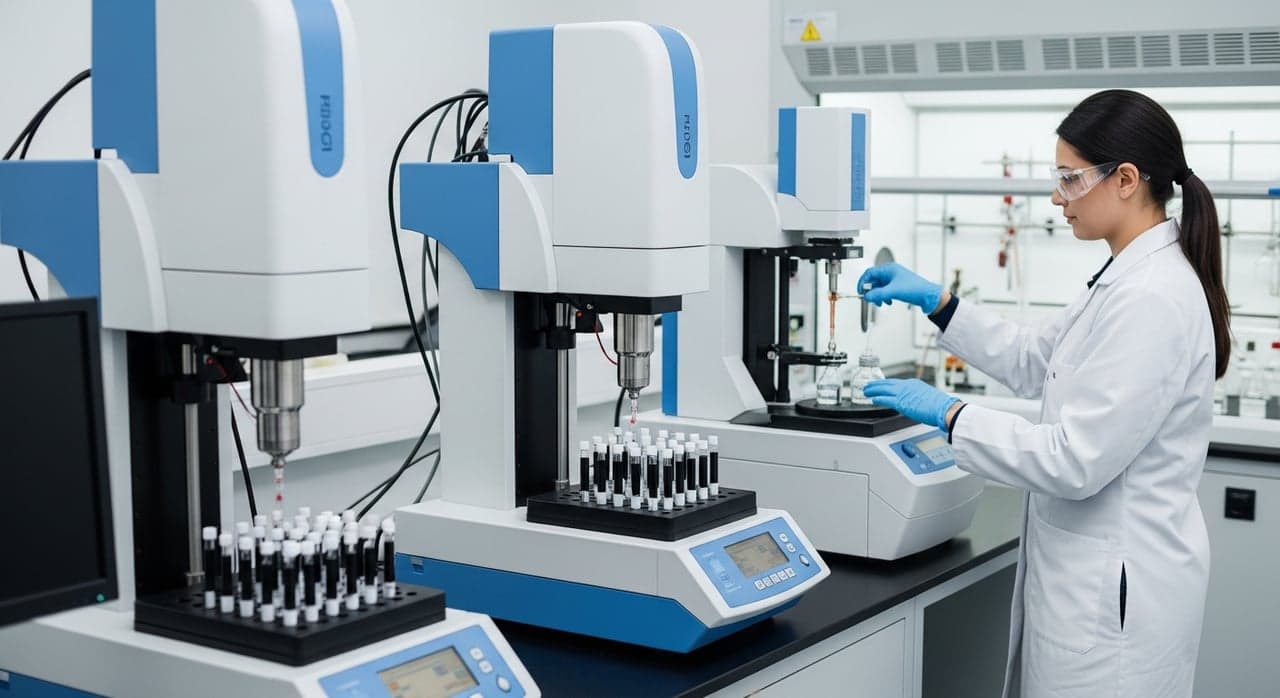
Safe storage, transport and handling are engineered from physical reality, and where that reality is assumed rather than measured the design inherits a hidden flaw. That might be an electrostatic ignition no one anticipated, a solid that cakes or sublimes, a melt that freezes in a line or a dust whose explosibility was never checked. Material characterisation generates the property dataset those decisions depend on, covering density and viscosity, melting and boiling behaviour, vapour pressure, particle size and dust characteristics, and electrostatic chargeability and conductivity assessed against the NFPA 77 bonding and grounding criteria. We tailor the test set to the actual handling question, whether bulk storage, pneumatic conveying, drumming or road or sea transport, and we translate the numbers into engineered safe handling specifications rather than a property table, so that containment, inerting, transfer and segregation are designed around the substance as it truly behaves.

How the study is executed
We open at physical property determination and close at material dossier & psi integration, and each stage hands the next one a record rather than a summary of it.
Determine physical properties, boiling point (ASTM D86), melting point (ASTM D87), vapour pressure (ASTM D2879), density (ASTM D5057), viscosity (ASTM D445), surface tension (ASTM D971), align with REACH Annex VII physico chemical.
Conduct thermal property testing, DSC for melting / glass transition, TGA for thermal decomposition / volatile content, specific heat (ASTM E1269), thermal conductivity (ASTM E1530), align with reactor / heat exchanger design.
Conduct material compatibility testing, peroxide formation (ASTM E298), water reactivity (UN TDG Class 4.3), self heating (UN Test N.4), pyrophoricity (UN Test N.2), align with UN TDG hazard classification.
For solids, characterise particle size (laser diffraction per ISO 13320), morphology (SEM), bulk density (ASTM D1895), flowability (Carr Index / Hausner Ratio), align with dust hazard assessment and storage / handling design.
Classify per UN TDG (Transport of Dangerous Goods) Class 1 to 9 and GHS (Globally Harmonised System) physical / health / environmental hazards, specify packing group, packaging requirements, and hazard labels.
Compile material characterisation dossier with test reports, classification, and handling recommendations, integrate with OSHA PSM Process Safety Information, SDS, REACH dossier, align with corporate product stewardship.
What the study covers in full
Outcomes of Material Characterisation and Safe Handling Evaluation
- We define the safe handling parameters
- We help prevent electrostatic ignition incidents
- We support proper container and conveying selection
- We build out hot work and grounding controls
- We align with NFPA 77 grounding requirements
- We support UN transport classification
- We document CGA and ASTM compliance
- We produce work that withstands customs and customer review
- We reinforce conveying and handling equipment design
- We improve grounding and bonding programmes
- We support operator training on handling
- We inform container and packaging selection
- We help you avoid handling related incidents and rework
- We reduce over specified handling equipment
- We support transport classification optimisation
- We improve the clarity of customer specifications
Codes & standards we work to
Triggers that signal the need
Where Material Characterisation and Safe Handling Evaluation applies
Tangible deliverables
- Material characterisation report
- Physical property data sheet
- Electrostatic property assessment
- UN transport classification
- Safe handling parameter compilation
- Customer specification input
Send us the scope
We will scope Material Characterisation and Safe Handling Evaluation against your site and come back with what it would take. Send us the unit, the P&ID revision it sits at and the inventory it holds.