OEE Improvement
We break overall equipment effectiveness into availability, performance and quality and target the losses behind each one
OEE
Improvement
A single effectiveness number hides where a machine is really losing time, speed and quality. Our team breaks overall equipment effectiveness into its availability, performance and quality components, each with its own family of losses known as the six big losses, and we design interventions aimed squarely at each loss. That means single minute exchange of die for setup, autonomous maintenance for minor stops, focused improvement for breakdowns and quality maintenance for defects. Our target is a sustained 85 percent, which is the world class benchmark.
Our implementation model
A practical, phased delivery approach that runs from gap assessment through operational embedding and is built around your regulatory context.
Measure OEE = Availability × Performance × Quality per asset, benchmark against world class (85%) and industry quartile.
Decompose losses by category, breakdowns, setup / changeover, minor stops, reduced speed, defects, startup losses.
Design loss targeted programmes, SMED for setup, autonomous maintenance for minor stops, focused improvement for breakdowns.
Integrate with TPM pillars, autonomous maintenance, planned maintenance, focused improvement, quality maintenance.
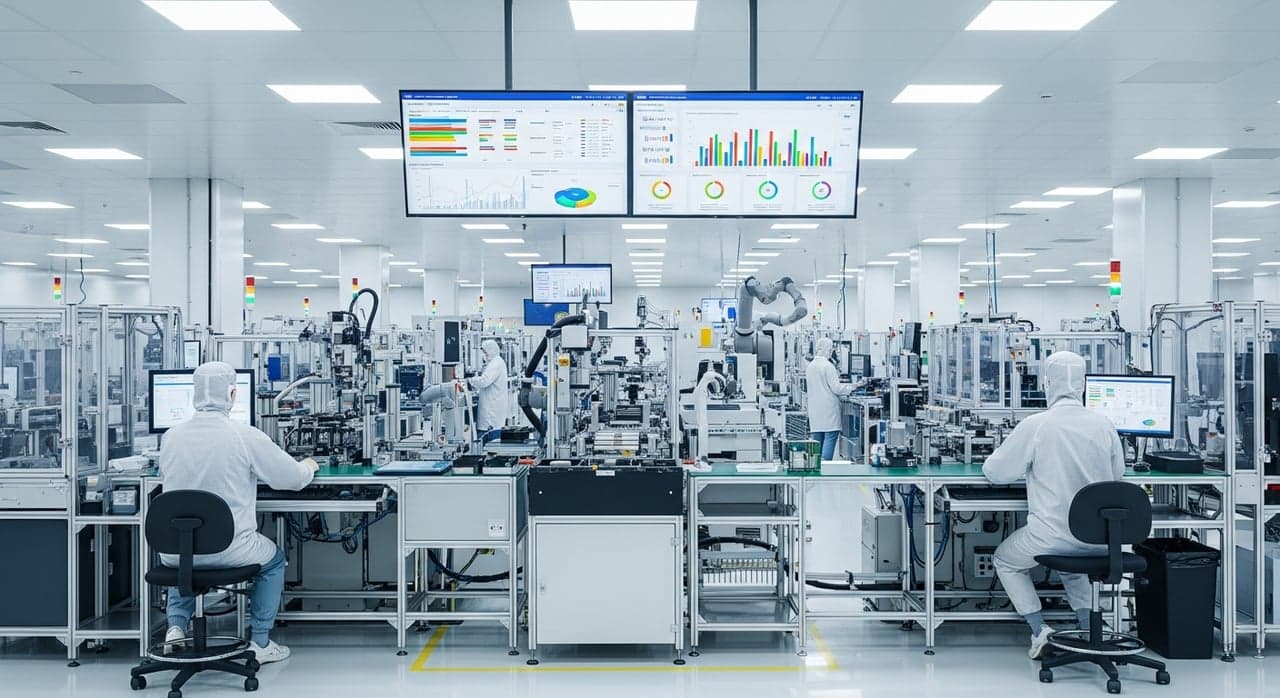
Deploy visual OEE dashboards, shift by shift, hour by hour where applicable, to drive operator level engagement.
Weekly improvement review, monthly TPM steering committee, quarterly business review against OEE target.
OEE in full scope
Value of OEE Improvement
- More reliable equipment means operators intervene far less often
- Standard changeover removes risky improvisation
- Predictable equipment means fewer emergency repairs
- Stable equipment allows a steadier and safer working pace
- KPIs aligned with ISO 22400
- Confidence presenting your OEE to customers at any time
- Performance measured against SEMI and industry benchmarks
- Maintenance records you can stand behind in any review
- OEE typically rises by 10 to 30 points
- Higher throughput with less stress on people and machines
- Quality improves as equipment becomes stable
- Changeover losses fall
- You avoid spending capital on extra capacity
- Maintenance and spares cost come down
- Rework and scrap are reduced
- Productivity rises on your existing footprint
Codes & standards we work to
Triggers that signal the need
Where OEE Improvement applies
Wellheads, separators, gas compression, FPSO topsides, produced water systems.
Distillation columns, reactors, heat exchangers, storage spheres, LPG handling.
Cryogenic exchangers, liquefaction trains, BOG compressors, storage and sendout.
Reactive systems, batch reactors, solvent handling, runaway reaction scenarios.
Boilers, HRSGs, steam headers, hydrogen systems, ammonia SCR units.
Sterile vessels, CIP/SIP, pressure fermenters, solvent recovery, spray dryers.
Tangible deliverables
- OEE baseline by asset
- Six big losses register
- Loss targeted improvement programmes
- TPM pillar integration plan
- Visual management dashboard
- OEE review cadence
Ready to start your project?
Speak with our team to scope an engagement tailored to your facility, regulatory context, and lifecycle stage.