Hazard Identification and Risk Analysis (RBPS Element 7)
HAZOP, LOPA, QRA and Bow Tie execution with a five year revalidation discipline
Hazard Identification and Risk
Analysis (RBPS Element 7)
Hazard Identification and Risk Analysis is the engine that turns process knowledge into ranked, defensible risk decisions. The element spans the full study toolkit, from HAZID at FEED and an IEC 61882 HAZOP at detailed engineering to a CCPS LOPA for independent protection layer credit, IEC 61511 SIL allocation, quantitative risk, fire and explosion and occupied building risk assessment for quantified consequence, Bow Tie for barrier visualisation, an ALARP demonstration for the residual risk argument and human reliability analysis for the human error pathways. What separates good work here from a paper PHA is action close out. Our team makes sure every recommendation travels from worksheet to management of change to engineering change to verified evidence, and that the traceability survives the five year statutory revalidation.
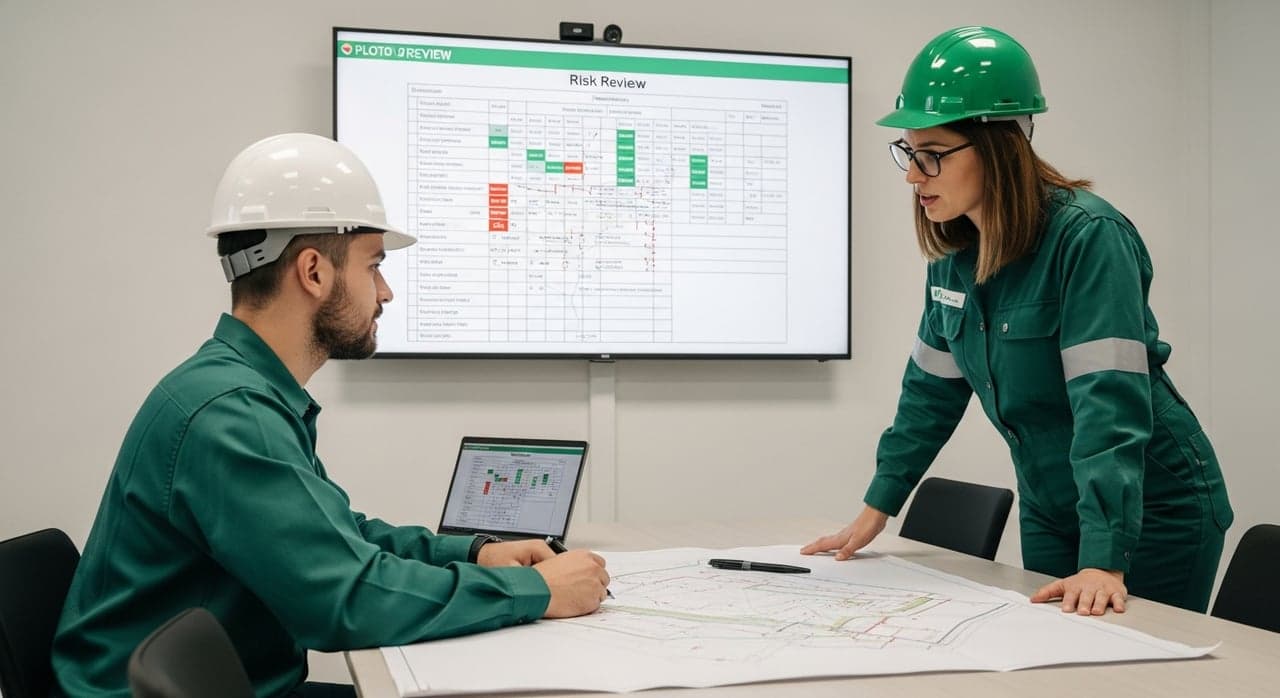
How the study is executed
A structured, facilitated process that runs from scope definition through close out and produces defensible, actionable outputs.
We map the applicable studies to each project stage and to your hazard inventory, aligning HAZID with the FEED gate, HAZOP with detailed engineering and LOPA and SIL with the design of the safety instrumented system.
We specify the right tool for each study type from PHA Pro, Easy HAZOP, exSILentia, BowTieXP and PHAST and enforce audit trail discipline and version control.
We select a facilitator certified by TÜV, IChemE or CCPS and make sure the team is multidisciplinary and includes operator and contractor representation.
We classify actions using the CCPS recommend, investigate and document approach, assign an owner and a target close out date, gate them by risk rank and integrate them with the management of change and corrective action database.
We run LOPA, quantitative risk, fire and explosion and ALARP studies sized to the relevant consequence severity and calibrate them against your site tolerable frequency matrix.
We deliver the five year statutory revalidation alongside partial revalidation triggered by management of change and integrate it with operator handover and shift training.

What the study covers in full
Outcomes of Hazard Identification and Risk Analysis (RBPS Element 7)
- Surfaces failure modes that walk through methods miss
- Defensible assignment of independent protection layer credit
- SIL allocation that prevents under protection
- A Bow Tie barrier register visible to operations
- OSHA PSM (e) PHA element compliance
- The IEC 61511 Cl.8 hazard and risk analysis prerequisite met
- A COMAH and Seveso safety case ALARP argument
- The MSIHC Schedule 1 risk assessment satisfied
- Operability findings captured at the FEED stage
- A lower commissioning rework rate
- A richer scenario library for operator training
- A management of change that can be defended when it is revisited
- A fix at FEED that costs ten to a hundred times less than one after startup
- A strong position with insurers through study quality
- A major accident cost avoided
- Capital efficiency through targeted controls
Codes & standards we work to
Triggers that signal the need
Where Hazard Identification and Risk Analysis (RBPS Element 7) applies
Wellheads, separators, gas compression, FPSO topsides, produced water systems.
Distillation columns, reactors, heat exchangers, storage spheres, LPG handling.
Cryogenic exchangers, liquefaction trains, BOG compressors, storage and sendout.
Reactive systems, batch reactors, solvent handling, runaway reaction scenarios.
Boilers, HRSGs, steam headers, hydrogen systems, ammonia SCR units.
Sterile vessels, CIP/SIP, pressure fermenters, solvent recovery, spray dryers.
Tangible deliverables
- A study programme plan for each project stage
- PHA, HAZOP, LOPA, SIL, QRA and fire and explosion workbooks
- An action register with ownership and close out tracking
- An ALARP demonstration report where it is required
- Bow Tie diagrams for the major accident hazards
- A five year revalidation calendar with management of change trigger criteria
Ready to start your project?
Speak with our team to scope an engagement tailored to your facility, regulatory context, and lifecycle stage.