Emergency Response and Fire Safety Training
We deliver scenario based emergency response team, fire warden and incident commander training
Emergency Response and Fire
Safety Training
In the first minutes of a major emergency the outcome is decided by trained reflex and not by the plan in the cabinet. Responders act as they have rehearsed, and untested teams default to hesitation at exactly the moment that decisiveness matters most. Our programme builds that reflex through graded, scenario based training for your full response structure, covering emergency response team members, fire wardens, incident commanders and crisis leadership teams. It progresses deliberately from classroom fundamentals through tabletop decision exercises to simulator and live fire drills that impose real time pressure, communication load and degraded information, the conditions under which command actually fails. We assess competence against NFPA 1001 and 1500, HAZWOPER and ICS and NIMS role standards rather than attendance, so the certificate reflects capability under stress.
How the programme is delivered
A structured learning journey from needs analysis through competency verification and ongoing coaching.
Define ER competency per NFPA 470 / OSHA 1910.120(q), Awareness (recognise hazard), Operations (defensive actions), Technician (offensive actions), Specialist (specific hazardous material), Incident Commander, align with site emergency response organisation.
Design curriculum per level, Awareness (8 hour initial, 4 hour refresher), Operations (24 hour initial, 8 hour refresher), Technician (40 hour initial, 24 hour refresher), align with OSHA HAZWOPER / NFPA 1500 / 1561.
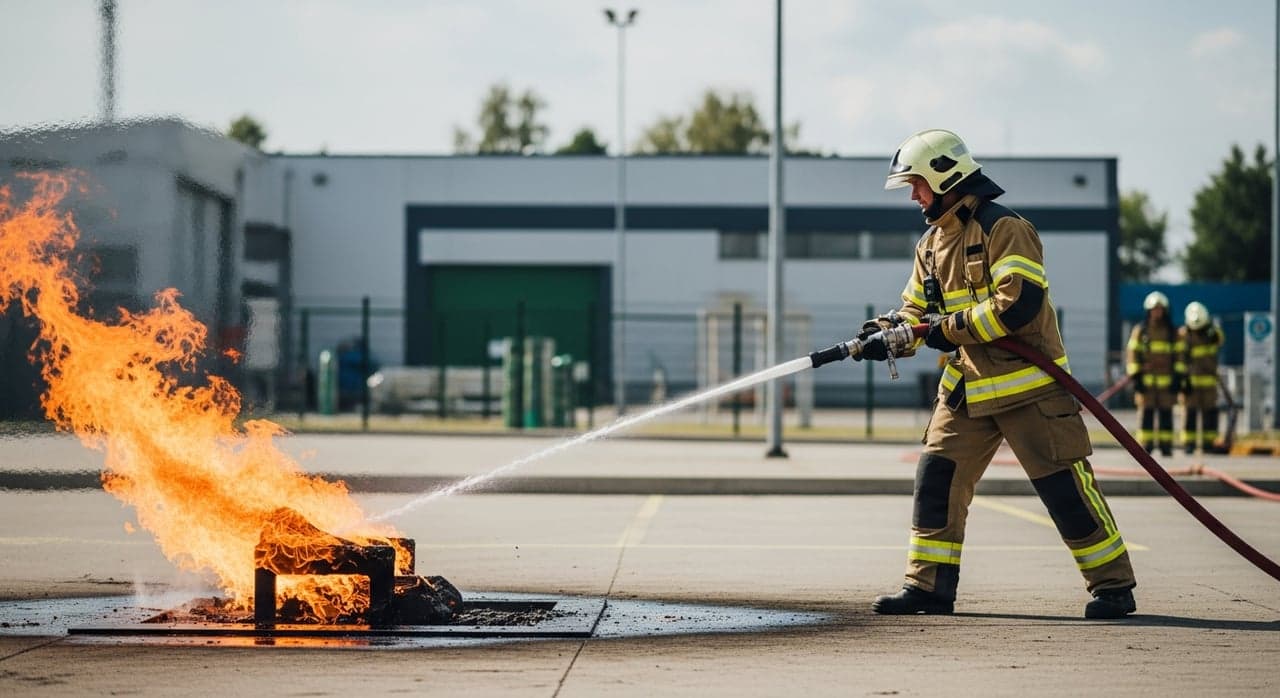
Deliver practical skill training, SCBA donning / doffing, hose handling, foam application, decontamination, gas testing, victim rescue, ICS form usage, specify training facility (fire training ground, simulator) and instructor qualification.
Design scenario based drills, fire (pool, jet, BLEVE), toxic release, spill, medical, security, specify drill frequency per OSHA 1910.38 / 1910.156, quarterly tabletop, annual functional, triennial full scale, align with mutual aid integration.
Conduct competency assessment per NFPA 470, written test (typical 70% pass), practical demonstration, peer review, specify certification per FEMA NIMS / IFSAC / Pro Board, align with annual refresher and recertification.
Audit programme per NFPA 1500 / 1521, training records, instructor qualification, facility maintenance, equipment serviceability, align with corporate HSE governance and learn from incident process.
What participants learn and practise

Outcomes of Emergency Response and Fire Safety Training
- We build confident and capable response teams
- We reduce incident escalation
- We strengthen response to fire and toxic events
- We power credible drill outcomes
- We map training to NFPA, OSHA HAZWOPER and ICS
- We document competency for the regulator
- We support the insurance underwriter request
- We produce records that survive AHJ scrutiny
- We harden cross function coordination
- We build drill realism
- We improve shift handover during incidents
- We support mutual aid integration
- We reduce the cost of incident escalation
- We help compress your insurance pricing
- We improve drill efficiency
- We enable credible emergency response team staffing
Codes & standards we work to
Triggers that signal the need
Where Emergency Response and Fire Safety Training applies
Wellheads, separators, gas compression, FPSO topsides, produced water systems.
Distillation columns, reactors, heat exchangers, storage spheres, LPG handling.
Cryogenic exchangers, liquefaction trains, BOG compressors, storage and sendout.
Reactive systems, batch reactors, solvent handling, runaway reaction scenarios.
Boilers, HRSGs, steam headers, hydrogen systems, ammonia SCR units.
Sterile vessels, CIP/SIP, pressure fermenters, solvent recovery, spray dryers.
Tangible deliverables
- Training curriculum and materials
- Competency assessment framework
- Simulator scenario library
- Drill design package
- Certification and refresher schedule
- Train the trainer programme
Ready to start your project?
Speak with our team to scope an engagement tailored to your facility, regulatory context, and lifecycle stage.