Functional Safety Training
We deliver IEC 61511 and 61508 competency programmes for engineers and operators
Functional Safety
Training
A safety instrumented system is only as dependable as the people who specify, build and maintain it, and IEC 61511 makes competence an explicit and auditable requirement rather than an assumption. Our functional safety training builds that competence across the whole lifecycle, covering SIL determination and verification, SIS design, operation and proof testing and management of change. We deliver curricula aligned to TUV and exida and tailored to each role, whether engineer, technician or operator, and we prepare your candidates for formal certification.
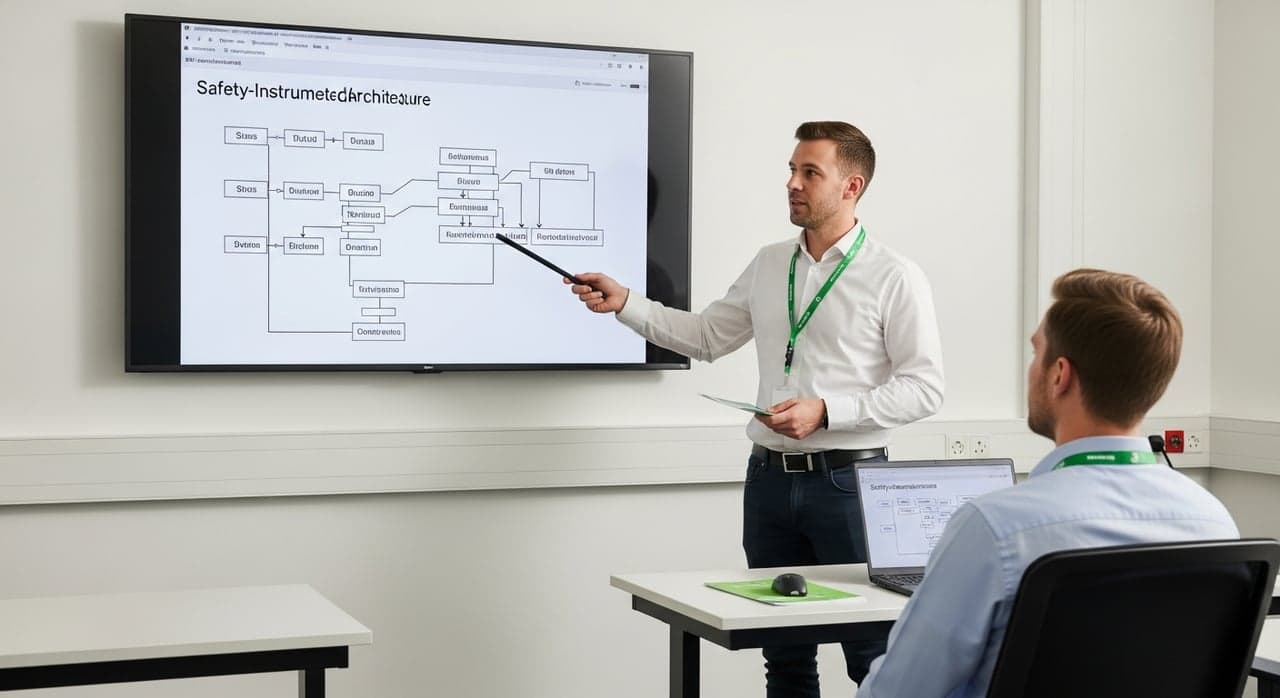
How the programme is delivered
A structured learning journey from needs analysis through competency verification and ongoing coaching.
Define FS competency per IEC 61511 Cl.5, Functional Safety Engineer (FSE), Functional Safety Engineering Professional (FSEng), Functional Safety Professional (FSP), TÜV / exida / SIRA certification, align with corporate technical career path.
Design curriculum, Foundation (FS basics, IEC 61511 / 61508 overview), Engineer (PHA / LOPA / SIL allocation), Professional (SRS / verification / FSA), Specialist (cyber per IEC 62443, prior use, complex SIS), align with TÜV / exida syllabus.
Deliver PHA / LOPA / SIL workshop training, facilitate practice HAZOP nodes, calculate LOPA worksheet, allocate SIL band, align with CCPS Guidelines for Hazard Evaluation Procedures and IEC 61511 Phase 3 to 5 requirement.
Deliver SIS design / verification training, FMEDA interpretation, PFD / PFH calculation per IEC 61508 6, architectural constraint per Route 1H / 2H, proof test design, align with vendor specific (Triconex, HIMA, ABB, AB) training.
Conduct certification examination per TÜV Rheinland / exida CFSE / CFSP / SIRA, written test (typical 80% pass), case study, oral defence, specify CPD per certification body (typical 30 hours/year).
Maintain training records per IEC 61511 Cl.5.2.5, individual competency matrix, certification expiry tracking, CPD log, specify recertification per certification body (typical triennial), align with FSA Stage audit.
What participants learn and practise

Outcomes of Functional Safety Training
- We build defensible competency across the SIS lifecycle
- We reduce design and operational errors
- We strengthen proof test discipline
- We support management of change for SIS modifications
- We align with the competency requirements of IEC 61511
- We support TUV and exida certification
- We document competency for the regulator
- We produce records that survive functional safety scrutiny
- We strengthen cross function SIS dialogue
- We improve vendor and contractor oversight
- We underpin the defence of realistic SIL claims
- We build enduring internal capability
- We curb SIS rework through competent design
- We avoid spurious trip cost through better operation
- We strengthen your response to vendor and customer audits
- We build internal capability rather than external dependency
Codes & standards we work to
Triggers that signal the need
Where Functional Safety Training applies
Wellheads, separators, gas compression, FPSO topsides, produced water systems.
Distillation columns, reactors, heat exchangers, storage spheres, LPG handling.
Cryogenic exchangers, liquefaction trains, BOG compressors, storage and sendout.
Reactive systems, batch reactors, solvent handling, runaway reaction scenarios.
Boilers, HRSGs, steam headers, hydrogen systems, ammonia SCR units.
Sterile vessels, CIP/SIP, pressure fermenters, solvent recovery, spray dryers.
Tangible deliverables
- Lifecycle aligned curriculum
- Role based competency matrix
- Workshop materials
- Case study library
- Certification preparation pack
- Competency assessment framework
Ready to start your project?
Speak with our team to scope an engagement tailored to your facility, regulatory context, and lifecycle stage.