Process Safety Training Programmes and HAZOP Workshops
We build role based PSM competency for your engineers, operators, supervisors and executives with TÜV, IChemE and NEBOSH aligned certifications
Process Safety Training Programmes
and HAZOP Workshops
Process safety training has grown from generic awareness courses into a discipline specific competency architecture, and our team maps every programme to the CCPS RBPS Training and Performance Assurance elements, the IChemE, TÜV and exida certification frameworks, the NEBOSH HSE and Process Safety Management qualifications and increasingly the AICHE PSE and SAChE academic pathway. The last two decades have shown repeatedly that competency gaps, particularly at the layer where engineers move into supervision, are the dominant root cause in major accident investigations, and Macondo in 2010, Husky Superior in 2018, T2 Labs in 2007, Bayer CropScience in 2008 and Tianjin in 2015 all cited competency shortfalls in CSB and equivalent findings. We design programmes that are role based so that operators, lead operators, panel operators, shift supervisors, plant engineers, plant managers and plant general managers each follow the right curriculum, scenario driven through simulators for operators and real incident cases for managers, assessed through both a knowledge test and a practical evaluation and refreshed on a five year cycle. We also integrate digital learning platforms, microlearning modules, virtual reality for rehearsing high hazard tasks and measurement of behavioural change before and after each course.
How the programme is delivered
A structured learning journey from needs analysis through competency verification and ongoing coaching.
Define competency framework per CCPS Competency / ABET / IChemE / Energy Institute, map competencies per role, Process Engineer (FED, HAZOP), Operations Manager (PSM), Operator (procedures, alarm response), align with corporate technical career ladder.
Conduct TNA per ISO 10015, identify competency gaps per role and individual, align with job task analysis (DACUM) and incident investigation lessons, specify learning objectives per Bloom's Taxonomy (knowledge / application / analysis).
Design courses per Kirkpatrick framework, Level 1 (reaction), Level 2 (learning), Level 3 (behaviour), Level 4 (results), modular curriculum per topic (PHA, MOC, MI, RCA, SIL), align with CCPS PSM 12 elements and OSHA PSM.
Design delivery, instructor led (classroom), virtual (Zoom / Teams), e learning (SCORM / xAPI), blended, integrate active learning, case studies (Buncefield, Texas City, BP Macondo, Bhopal), tabletop exercises, simulators (OTS, virtual reality).
Design assessment per competency level, written examination, practical demonstration, oral examination, certify per CCPS / IChemE / TÜV / exida, specify CPD requirement (typical 30 hours/year).
Measure programme effectiveness, Level 1 to 4 Kirkpatrick metrics, incident reduction, PHA quality improvement, benchmark vs industry peers (CCPS, AIChE), align with corporate L&D and HSE governance.
What participants learn and practise

Outcomes of Process Safety Training Programmes and HAZOP Workshops
- Competent HAZOP teams find more hazards and produce stronger action items
- Trained operators recognise abnormal situations and respond to them correctly
- LOPA and SIL competency keeps your team from over crediting or under crediting protection layers
- Safety culture training reduces at risk behaviours at every level
- You meet the OSHA PSM employee training element
- You satisfy the IEC 61511 competency requirements for functional safety personnel
- Your people earn NEBOSH and professional institution CPD credit
- You hold documented training records that withstand regulator and auditor review
- Your HAZOP facilitators produce higher quality study documentation
- Trained scribes make HAZOP meetings more efficient and productive
- Incident investigation training shortens the time your team needs to reach a root cause
- Leadership training lifts your safety culture metrics
- Well facilitated HAZOP studies finish on time and on budget
- Competent teams lean less on outside specialists
- Your training investment prevents the cost of incidents that flow from competency failures
- You avoid the cost of poor quality process safety studies that need reworking
Codes & standards we work to
Triggers that signal the need
Where Process Safety Training Programmes and HAZOP Workshops applies
We train upstream, midstream and downstream operations teams and PSM coordinators.
We build process safety competency for your process, research and manufacturing engineers.
We support plant operations, engineering and HSE teams at refineries and petrochemical sites.
We work with power plant and utility engineers who carry process safety management obligations.
We give LNG plant engineers and operators the HAZOP and functional safety competency they need.
We serve any process industry organisation that carries process safety training obligations.
Tangible deliverables
- A training needs analysis with clear learning objectives
- Course materials including slides, exercises and reference documents
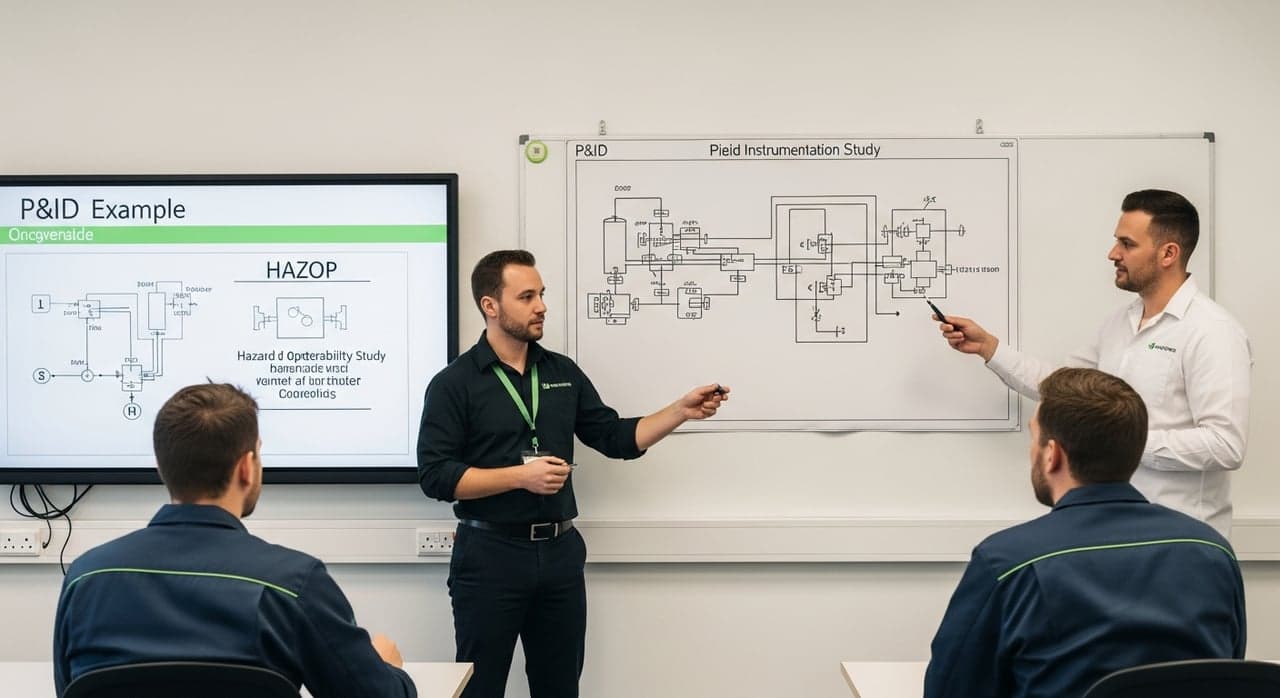
- HAZOP practice workshops built on model P and IDs
- Post course assessment and competency verification
- Attendance certificates and CPD records
- An updated training register
- Facilitator mentoring support
- A refresher training schedule
Ready to start your project?
Speak with our team to scope an engagement tailored to your facility, regulatory context, and lifecycle stage.