Lightning Protection Risk Assessment and System Design
We run the IEC 62305 2 risk calculation to establish the protection level your site actually needs, then design the air termination, down conductor, earthing and surge protection to match it
Lightning Protection Risk Assessment
and System Design
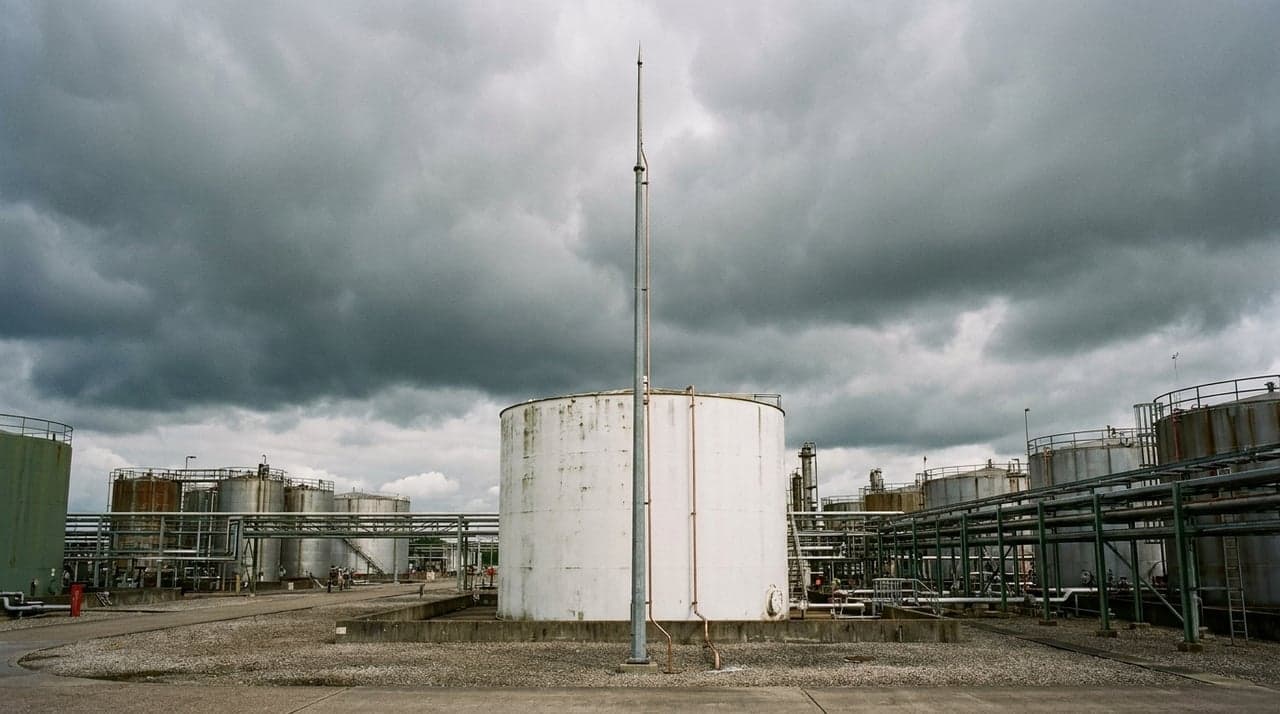
Lightning protection is one of the few hazards where the required level of protection is a calculated output rather than an engineering preference. IEC 62305 2 works from the local flash density, the collection area of the structure, the construction and contents, the occupancy and the consequence of loss, and returns a risk that is then compared against a tolerable value. That calculation decides the protection level, and the protection level decides the rolling sphere radius, the mesh size, the down conductor spacing and the surge protective device coordination. Our work runs that assessment properly rather than defaulting to a level and fitting a finial to it, and for a process plant it also covers the parts that are frequently missed: the risk to services entering the structure, the bonding of external conductive parts, and the surge protection of the instrumentation and control systems that carry the real loss potential on a modern site. On a tank farm we work to the additional requirements that apply to flammable atmospheres, where an unbonded floating roof or a poorly earthed vent is the ignition path that matters.
Lightning Protection Risk Assessment and System Design workflow
Verify the single line diagram against the installation, and collect utility fault levels, transformer and cable data, and protective device settings.
Build the impedance model of the distribution system, including generation, motor contribution and every credible operating configuration.
Run short circuit and protective device coordination, since incident energy is governed by clearing time as much as by fault current.
Calculate the hazard at each working point across the operating configurations, and identify where the result is driven by a slow upstream device.
Test setting changes, maintenance mode, arc resistant equipment and remote operation, and rank them on the reduction each actually delivers.
Issue the equipment labels, the boundary and PPE schedule, and the energised work procedure that the calculation supports.
Every deliverable from basis to handover
Complete Lightning Protection Risk Assessment and System Design scope covering every calculation, drawing, specification, and construction support activity.
Outcomes of Lightning Protection Risk Assessment and System Design
- We establish the protection level from a calculation rather than an assumption
- We close the ignition paths that matter on a flammable inventory
- We protect occupied structures against side flash and step potential
- We bond the services that would otherwise carry a surge inside
- We assess to IEC 62305 2 and design to IEC 62305 3 and 4
- We apply IS 2309 and IS/IEC 62305 for Indian installations
- We cover tank protection to API RP 545
- We document the basis for the protection level selected
- We protect instrumentation and control against surge damage
- We reduce unplanned outages caused by transient events
- We set a defensible inspection and test interval
- We identify where an existing system has degraded
- We avoid over protecting a structure the calculation does not require it for
- We target surge protection where the loss potential actually sits
- We reduce repeat damage to electronic systems
- We support insurance discussion with a calculated basis
Codes & standards we work to
Triggers that signal the need
Where Lightning Protection Risk Assessment and System Design applies
Tangible deliverables
- IEC 62305 2 risk assessment with the calculated protection level
- Air termination layout with rolling sphere verification
- Down conductor routing and separation distance calculation
- Earth termination design and target resistance
- Surge protective device coordination schedule across power and signal
- Tank protection arrangement to API RP 545 where applicable
- Bonding schedule for incoming services and external conductive parts
- Inspection, test and maintenance schedule with measured parameters
Send us the scope
We will scope Lightning Protection Risk Assessment and System Design against your site and come back with what it would take. Send us the process conditions, the equipment list and the stage the design has reached.