Escape, Evacuation and Rescue Analysis (EERA)
Quantified evacuation feasibility for offshore, onshore, and high rise facilities
Escape, Evacuation and Rescue
Analysis (EERA)
On an offshore installation there is nowhere to run, so escape, evacuation, and rescue must work within the time the hazard allows, against a fire, blast, or gas event developing on the very structure that holds the only refuge. EERA quantifies that feasibility and asks whether people can move from the point of alarm to a temporary refuge, then to an evacuation means, and ultimately to recovery, before escalating thermal, smoke, or structural conditions cut the path. Our team assesses escape route survivability, temporary refuge integrity and endurance, primary and secondary evacuation means, and rescue provision against the credible major accident scenarios and their timelines, all to ISO 15544, NORSOK S 001, and UK PFEER. The analysis exposes where the timeline does not close, whether through a compromised route, an under endured refuge, or an evacuation means lost to the very event it must escape, and it defines the design or procedural changes that make survival demonstrable for your onshore and high rise facilities as well as offshore.
How the study is executed
We open at offshore eera scope & regulatory brief and close at eera documentation & drill validation, and each stage hands the next one a record rather than a summary of it.
Define EERA scope per PFEER (Prevention of Fire and Explosion, and Emergency Response, Regulations 1995, UK), NORSOK Z 013, SOLAS / IMO MODU code, align with HSE Offshore Safety Case and CCPS Offshore guidance.
Identify Design and Safety related Hazardous Activities (DSHA) and credible worst case events, audit escape routes for redundancy (minimum 2 routes), survivability (PFP rating, smoke control), and accessibility (mobility impaired, injured).
Establish TR performance standards per PFEER, smoke / toxic gas integrity (overpressure ventilation), thermal integrity (PFP rating), structural integrity (blast resistance), endurance (typically 1 to 2 hours per scenario).
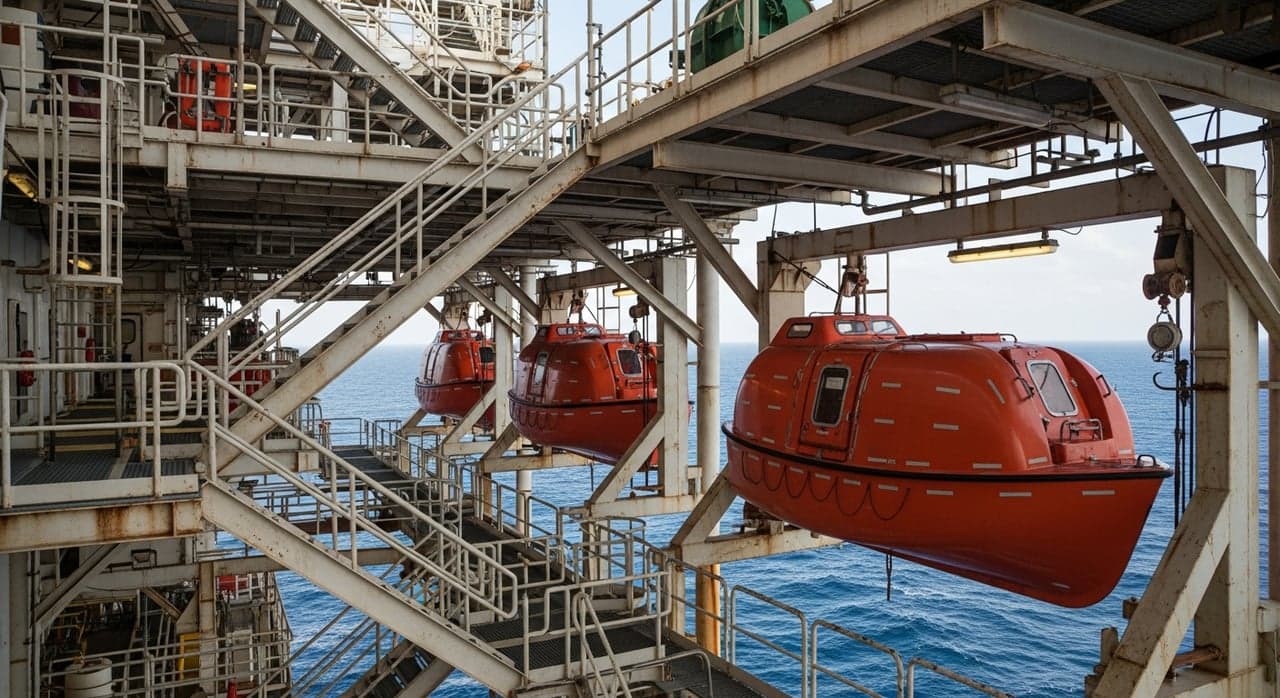
Assess evacuation systems, primary (TEMPSC lifeboats per SOLAS, free fall lifeboats per MODU code), secondary (life rafts, sea jump), tertiary (helicopter), specify launch / retrieval testing per PFEER.
Assess rescue capability, Standby Vessel per OPITO (UK), Fast Rescue Craft (FRC), helicopter SAR coverage, specify recovery to safe haven (typically <2 hours) and medical capability (TR + onshore receiving hospital).
Compile EERA report with hazard scenarios, TR performance, evacuation system assessment, rescue capability, specify drill programme per PFEER Regulation 16, align with Offshore Safety Case and HSE inspection.
What the study covers in full
Outcomes of Escape, Evacuation and Rescue Analysis (EERA)
- We validate that your personnel can escape the credible scenarios
- We identify route bottlenecks and equipment gaps
- We reinforce temporary refuge survivability under fire and explosion
- We improve the realism of your rescue planning
- We satisfy NORSOK S 001 and UK PFEER
- We support your IMO LSA Code compliance
- We document the EERA for your safety case
- We map the analysis to API RP 14J for offshore
- We help you design realistic evacuation drills
- We improve crew familiarisation
- We support standby vessel positioning
- We tighten your emergency response timing
- We target life saving appliance upgrades to the gaps we identify
- We reduce over specification of equipment you do not need
- We evidence the life saving appliance provision a regulator checks
- We support your insurance underwriting dialogue
Codes & standards we work to
Triggers that signal the need
Where Escape, Evacuation and Rescue Analysis (EERA) applies
Tangible deliverables
- EERA report with quantified scenarios
- Route capacity and bottleneck analysis
- Temporary refuge and muster point survivability assessment
- Life saving appliance adequacy gap report
- Improvement and upgrade action register
- Drill design recommendations
Send us the scope
We will scope Escape, Evacuation and Rescue Analysis (EERA) against your site and come back with what it would take. Send us the unit, the P&ID revision it sits at and the inventory it holds.