Incident Command System (ICS) Implementation
We deploy FEMA NIMS and ICS, a scalable command structure proven across petroleum, chemical, wildfire, hurricane and pandemic events
Incident Command System
(ICS) Implementation
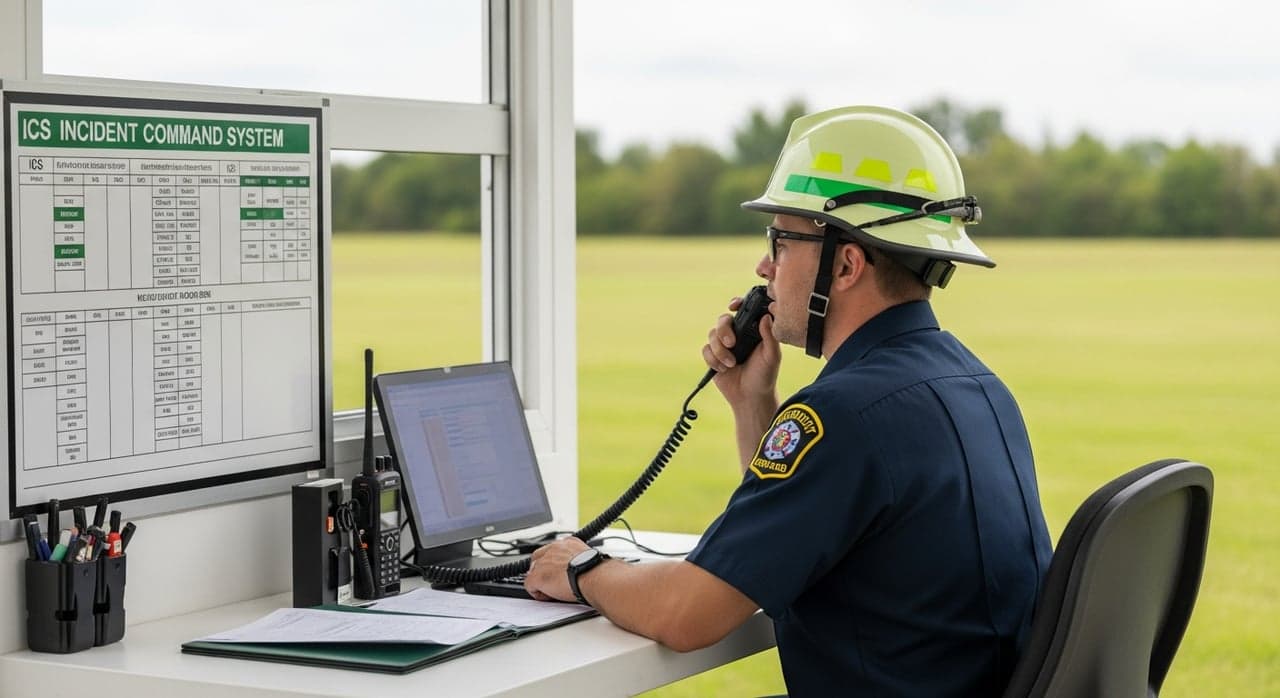
The Incident Command System grew out of California wildfire response in the 1970s and was codified at the federal level through the FEMA National Incident Management System in 2004. It has become the working global standard for organised emergency response, adopted across petroleum, chemical, marine, aviation, hospital and government emergency operations. ICS gives you a scalable management framework that runs across five functional sections, namely Command, Operations, Planning, Logistics and Finance and Administration, with defined positions held to span of control limits that are typically three to seven, with standardised forms running from the ICS 201 Incident Briefing through to the ICS 230 Daily Meeting Schedule, and with the unified command structure that bridges site, mutual aid and external agency response. The 2010s and 2020s have tested ICS at a scale never seen before, from Deepwater Horizon in 2010 with more than 5,000 personnel across multiple sites, through Fukushima in 2011 and the COVID 19 response with national level ICS style activation, to the Maui wildfires in 2023, and that history shows both its strengths and where deployment maturity matters. Modern ICS implementation now also works through cyber incident integration via CISA and NIST IR, through public information and social media response, and through the protocols for multi site and multi jurisdiction coordination.
How the study is executed
We open at ics scope & nims alignment and close at training & exercise programme, and each stage hands the next one a record rather than a summary of it.
Define ICS implementation scope per FEMA NIMS / NFPA 1561 / ISO 22320, incident command, unified command (multi agency), area command (multi incident), align with national / regional emergency management framework.
Design ICS positions per NIMS, Incident Commander, Command Staff (PIO, Safety, Liaison), General Staff (Operations, Planning, Logistics, Finance), specify competency per FEMA ICS 100 / 200 / 300 / 400 / 700 certification.
Apply NIMS span of control (5 1 supervision ratio), design modular expansion strategy, Type 5 (initial response) → Type 4 → Type 3 → Type 2 → Type 1 (catastrophic incident) per scope and duration.
Implement ICS forms, ICS 201 (Incident Briefing), 202 (Incident Objectives), 203 (Organisation Assignment), 204 (Assignment List), 205 (Communications Plan), 206 (Medical Plan), align with NIMS ICS Form Series.
Design Multi Agency Coordination System (MACS) per NIMS, Emergency Operations Centre (EOC), Joint Information Centre (JIC), Multi Agency Coordination Centre (MACC), align with FEMA NIMS Tier I V certification.
Deliver ICS training per FEMA NIMS, ICS 100 / 200 / 300 / 400 / 700 / 800 per role, conduct annual ICS exercise per NIMS framework, align with corporate emergency management and HSE leadership.

What the study covers in full
Outcomes of Incident Command System (ICS) Implementation
- We standardise incident command across events
- We strengthen multi agency coordination
- We improve resource allocation
- We build a scalable response capability
- We keep you aligned with FEMA NIMS and ICS
- We support NFPA 1561
- We document capability for the regulator
- We produce work that holds firm under AHJ review
- We sharpen cross function coordination
- We standardise the response across your sites
- We strengthen mutual aid integration
- We build documented incident records
- We cut the cost of incident escalation
- We improve resource utilisation
- We give your underwriters quantified evidence to assess
- We support realistic emergency response team staffing
Codes & standards we work to
Triggers that signal the need
Where Incident Command System (ICS) Implementation applies
Tangible deliverables
- An ICS organisation design
- Position specific job aids
- A training curriculum from ICS 100 400
- An ICS forms package covering 201, 202 and 204 onward
- A mutual aid integration protocol
- A drill validation framework
Send us the scope
We will scope Incident Command System (ICS) Implementation against your site and come back with what it would take. Send us the unit, the P&ID revision it sits at and the inventory it holds.