Runaway Reaction and Calorimetry Support
Adiabatic and isothermal calorimetry that quantifies runaway risk
Runaway Reaction and Calorimetry
Support
A thermal runaway is one of the most destructive events a reacting system can produce, a self accelerating exotherm in which heat generation outruns heat removal and drives temperature and pressure upward until the vessel or its relief system is overwhelmed. Calorimetry is how our team quantifies that hazard rather than guesses at it. We use DSC screening to find exothermic onset, RC1 reaction calorimetry to map the heat release rate and cooling demand of your intended process, and ARC and adiabatic methods to characterise the worst case runaway through adiabatic temperature rise, time to maximum rate, gas generation, and the onset of secondary decomposition. We then interpret the data through the Stoessel criticality classification, which places a process on a severity and probability scale and tells the designer what actually protects it, whether that is sufficient cooling and control, a quench or dump, or an emergency relief system sized to the measured energetics. The output turns reactive hazard management from intuition into a defensible thermal basis of safety.
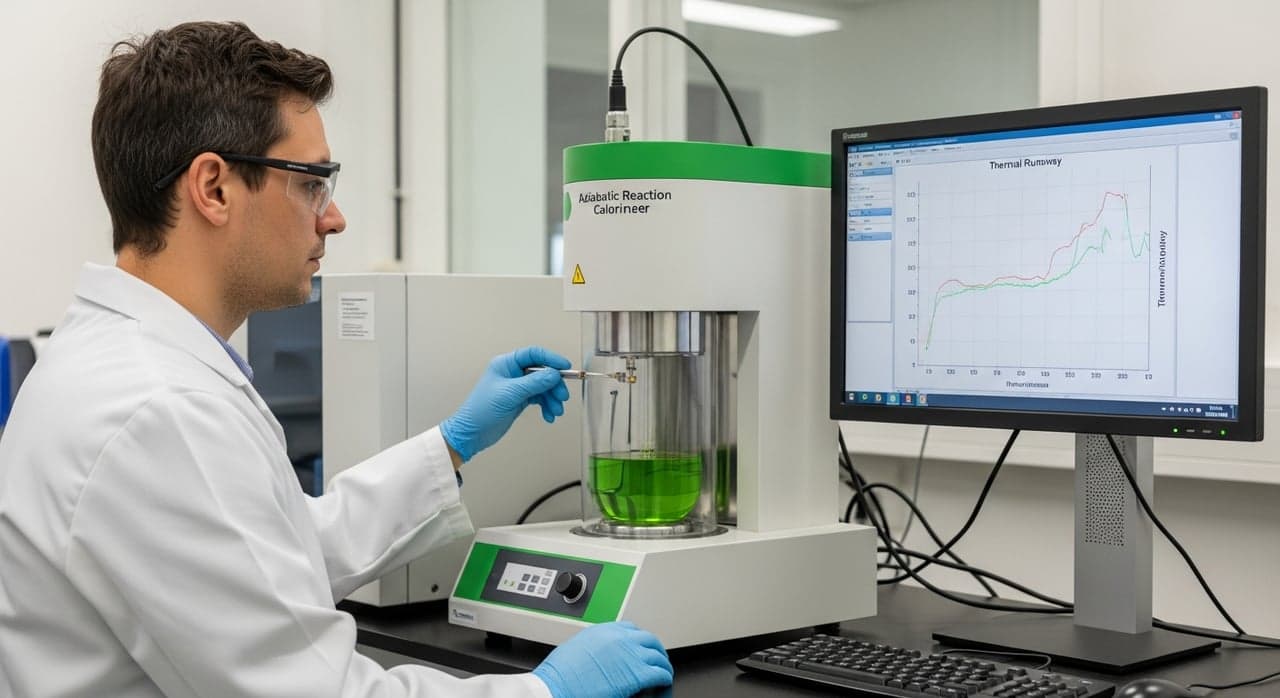
Runaway Reaction and Calorimetry Support workflow
Conduct preliminary screening per CEFIC / AIChE / OSHA PSM with literature review, structural alerts (Bretherick / Yoshida indices), and DSC (Differential Scanning Calorimetry) onset temperature, classify reaction per Stoessel scenario class 1 to 5.
Conduct adiabatic calorimetry, ARC (Accelerating Rate Calorimeter), VSP2 (Vent Sizing Package), Phi Tec II, APTAC, measure adiabatic temperature rise (ΔTad), self heat rate (dT/dt), and time to maximum rate (TMRad), align with DIERS test methodology.
Calculate Maximum Temperature of Synthesis Reaction (MTSR) per process scenario, normal, cooling failure, dosing stop, runaway, define safe operating window with cooling failure scenario tolerance, align with IChemE / EFCE good practice.
Size emergency relief per DIERS methodology with two phase flow consideration, homogeneous, bubbly, or churn turbulent regime per OMEGA method, specify vent area, piping, and knock out / quench drum, align with API 520 / IChemE Workbook.
Specify reactor control strategy, cascade temperature control, semi batch dosing control, model predictive, design emergency cooling (drown out, dilution, ice slurry, vaporisation), integrate with SIS for emergency shutdown / relief activation.
Develop operating procedure with cooling failure response, dosing failure response, and emergency depressurisation, deliver operator training with scenario simulation, integrate with HAZOP / LOPA / SIL allocation and BEP documentation.

Every deliverable from basis to handover
Complete Runaway Reaction and Calorimetry Support scope covering every calculation, drawing, specification, and construction support activity.
Outcomes of Runaway Reaction and Calorimetry Support
- We help you prevent catastrophic runaway reaction events
- We define the safe operating envelope for your process
- We drive your emergency cooling design
- We provide the data your DIERS vent sizing needs
- We provide the data your DIERS vent sizing depends on
- We map the work to CCPS reactive chemical guidance
- We support your OSHA PSM reactive chemistry programmes
- We document the UN SADT for your transport classification
- We define safe batch processing windows for your operators
- We strengthen your MOC for new chemistry
- We improve operator training on runaway awareness
- We inform your cooling system design margins
- We help you avoid catastrophic batch loss and equipment damage
- We target your cooling capex to true thermal needs
- We right size your emergency relief area
- We support your insurance dialogue on reactive risk
Codes & standards we work to
Triggers that signal the need
Where Runaway Reaction and Calorimetry Support applies
Tangible deliverables
- DSC and RC1 test data
- ARC adiabatic test report
- Time to Maximum Rate and onset temperature analysis
- Safe operating window definition
- Vent sizing input data
- Emergency cooling recommendation
Send us the scope
We will scope Runaway Reaction and Calorimetry Support against your site and come back with what it would take. Send us the process conditions, the equipment list and the stage the design has reached.