There is a particular kind of confidence that comes from finding your material in a published table. Kst of 150, St 1, protection sized, move on.
The trouble is that the entry in the table describes a sample somebody else tested, at a particle size distribution somebody else had, at a moisture content somebody else's process produced. Your material has been through your milling, your drying and your conveying, and it may behave very differently.
Particle size is usually the culprit. Reduce the median size and the specific surface area climbs, and Kst climbs with it. A material sitting comfortably in St 1 as delivered can move well into St 2 after milling. The powder that matters for an explosion is not the powder you bought. It is the fines that accumulate in the dust collector, on the beams and above the false ceiling.
The five things an explosion needs
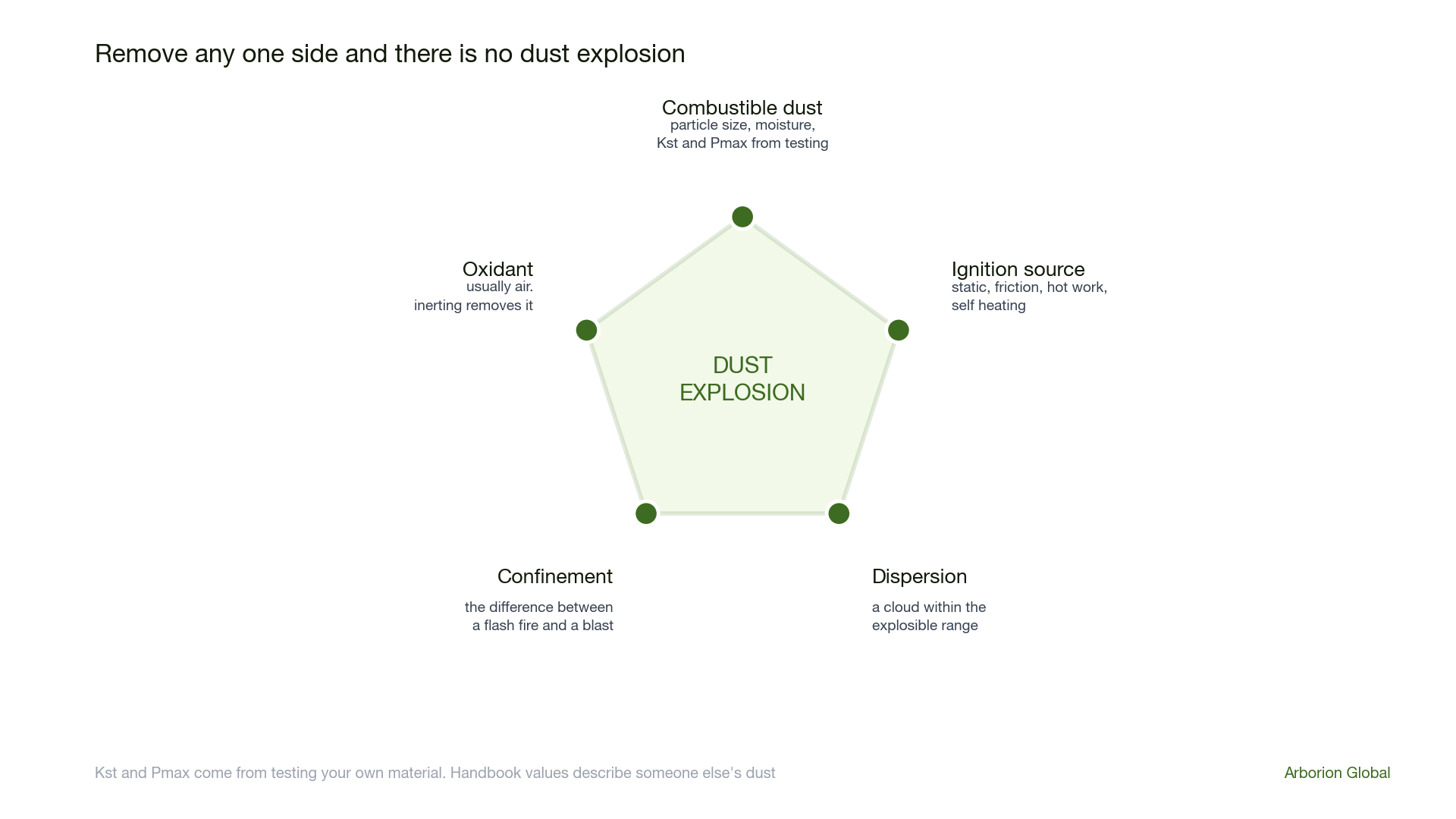
The pentagon is useful because it maps onto your options. Fuel, oxidant, dispersion, confinement and an ignition source. Inerting removes the oxidant. Design and housekeeping attack dispersion and fuel. Venting, suppression and isolation deal with confinement and its consequences. Ignition control is the one most sites lean on hardest and the one that deserves the least confidence.
The cubic law and what Kst really is
Kst is not a fundamental property in the way a heat of combustion is. It is a normalised rate of pressure rise, defined so that results from a test vessel can be applied to a plant enclosure of different size.
- maximum rate of pressure rise, bar/s
- enclosure volume, m³
- deflagration index, bar·m/s
The consequence is worth stating plainly. The same dust in a larger enclosure produces a lower rate of pressure rise but reaches a similar peak pressure. Volume changes how fast, not how hard.
- St 0. Kst = 0. No explosion observed under test conditions.
- St 1. Kst up to 200 bar·m/s. Weak to moderately explosible. Most organic powders, flour, many polymers.
- St 2. Kst 201 to 300 bar·m/s. Strongly explosible.
- St 3. Kst above 300 bar·m/s. Very strongly explosible. Typically metal dusts such as aluminium and magnesium.
St class sets the severity, not the likelihood. An St 1 dust in a plant with poor housekeeping and no isolation is a far worse proposition than an St 2 dust that is properly contained, vented and cleaned. Do not let a favourable class close the conversation.
The numbers worth having for your own material
Kst and Pmax size the protection. Vent area, suppression capacity and containment design all follow from them. But four other properties decide whether an ignition is credible in the first place, and they are the ones most often missing from a file.
- Minimum ignition energy. Below roughly 25 millijoules, ordinary handling and human body discharges become credible initiators. Below a few millijoules the material is seriously static sensitive and bonding, earthing and material selection move from good practice to critical controls.
- Minimum ignition temperature, for the cloud and separately for a settled layer. Layer MIT is often much lower than cloud MIT, which is why a bearing running hot under a covering of product is a recurring incident scenario.
- Minimum explosible concentration. The lower bound on a cloud that can propagate, and the number the layer arithmetic below is compared against.
- Limiting oxygen concentration. Sets the target if inerting is the chosen strategy.
Secondary explosions, and the arithmetic that matters
This is the part that gets underestimated. A primary event inside a mill, a dryer or a collector may be contained and survivable. What kills people is the blast wave lifting years of accumulated layers off beams, ledges, cable trays and roof structures, creating a far larger cloud in the occupied volume, and igniting it.
Whether that is possible is a calculation, not a judgement. If a layer of thickness t covering a fraction f of the surfaces is lifted into a cloud of height h, the concentration follows directly.
- dispersed dust concentration, kg/m³
- layer thickness, m
- bulk density of the settled dust, kg/m³
- fraction of the surface covered
- height of the resulting cloud, m
Put realistic numbers in and the result is uncomfortable. A layer under a millimetre thick, at a typical organic bulk density, dispersed to the height of a working space, comfortably exceeds a typical MEC. That is the whole basis of the housekeeping thresholds in NFPA 654, and it is why a layer you could write your name in is already a reportable condition rather than an untidy one.
Kst class and layer accumulation calculator
The cubic law, and whether a settled layer can make an explosible cloud.
The layer calculation assumes the whole layer lifts and disperses uniformly to the stated height. Real dispersion is violent and uneven, so this sizes the question rather than answering it. Its value is that it turns an argument about whether housekeeping matters into an argument about numbers.
What it looks like when the layers go up
On 7 February 2008 an explosion tore through the Imperial Sugar refinery at Port Wentworth, Georgia. Sugar dust had accumulated throughout the packing buildings over years. A primary explosion in an enclosed conveyor lifted those accumulations, and the secondary explosions that followed destroyed much of the plant. Fourteen people were killed and thirty six injured. The US Chemical Safety Board investigated and found that the accumulations, and the absence of an effective housekeeping programme, were central to the severity.
This video is hosted by YouTube and loads only after you accept cookies.
The primary event was survivable. The secondary events were not. That distinction is the reason the arithmetic above deserves attention, and the reason the cleanliness of the surfaces nobody inspects matters more than the tidiness of the floor.
What a dust hazard analysis is actually for
NFPA 652 requires a dust hazard analysis for facilities handling combustible particulate solids, and it is not a paperwork exercise. Done properly it walks the process, finds where explosible concentrations can exist, identifies where accumulations build, tests the material as it actually exists at each point, and specifies protection matched to the measured properties.
Done improperly it cites a handbook value, notes that the site has a cleaning schedule, and concludes the risk is managed.
NFPA 652 Standard on the Fundamentals of Combustible Dust. NFPA 654 for the manufacturing, processing and handling of combustible particulate solids, including the housekeeping action levels. NFPA 68 for deflagration venting and NFPA 69 for explosion prevention systems. ASTM E1226 for Kst and Pmax, E1515 for MEC, E2019 for minimum ignition energy and E1491 for cloud ignition temperature. Commodity specific standards apply for metals, agricultural dusts and wood.
Three questions worth asking today
- Has the material been tested as it exists at the point of highest fines concentration, rather than as delivered?
- Do you know the layer ignition temperature as well as the cloud ignition temperature?
- When did anyone last look on top of the pipe racks, the beams and above the false ceiling?
The last one is not rhetorical. In most plants where a serious secondary explosion has happened, somebody could have answered it honestly beforehand and chose not to ask.