OSHA Process Safety Management (29 CFR 1910.119)
We engineer full PSM compliance that holds up through OSHA NEP inspections and CSB scrutiny
OSHA Process Safety Management
(29 CFR 1910.119)
OSHA PSM under 29 CFR 1910.119 was adopted in 1992 following Bhopal, Piper Alpha and Phillips 66, and it remains the primary statutory framework in the United States for facilities that handle highly hazardous chemicals above the Appendix A thresholds. The OSHA refinery and chemical National Emphasis Programs under CPL 03 00 021 and CPL 03 00 014 push inspection focus toward PHA action close out, MOC discipline, mechanical integrity and Process Safety Information accuracy. Modern PSM execution has to withstand multi week NEP inspections, CSB recommendations and parallel EPA RMP reviews in a tougher enforcement environment, and it has to integrate with CCPS RBPS, IEC 61511 functional safety and API RP 754 reporting expectations. Our team builds the programme so that it carries all of that without rework.
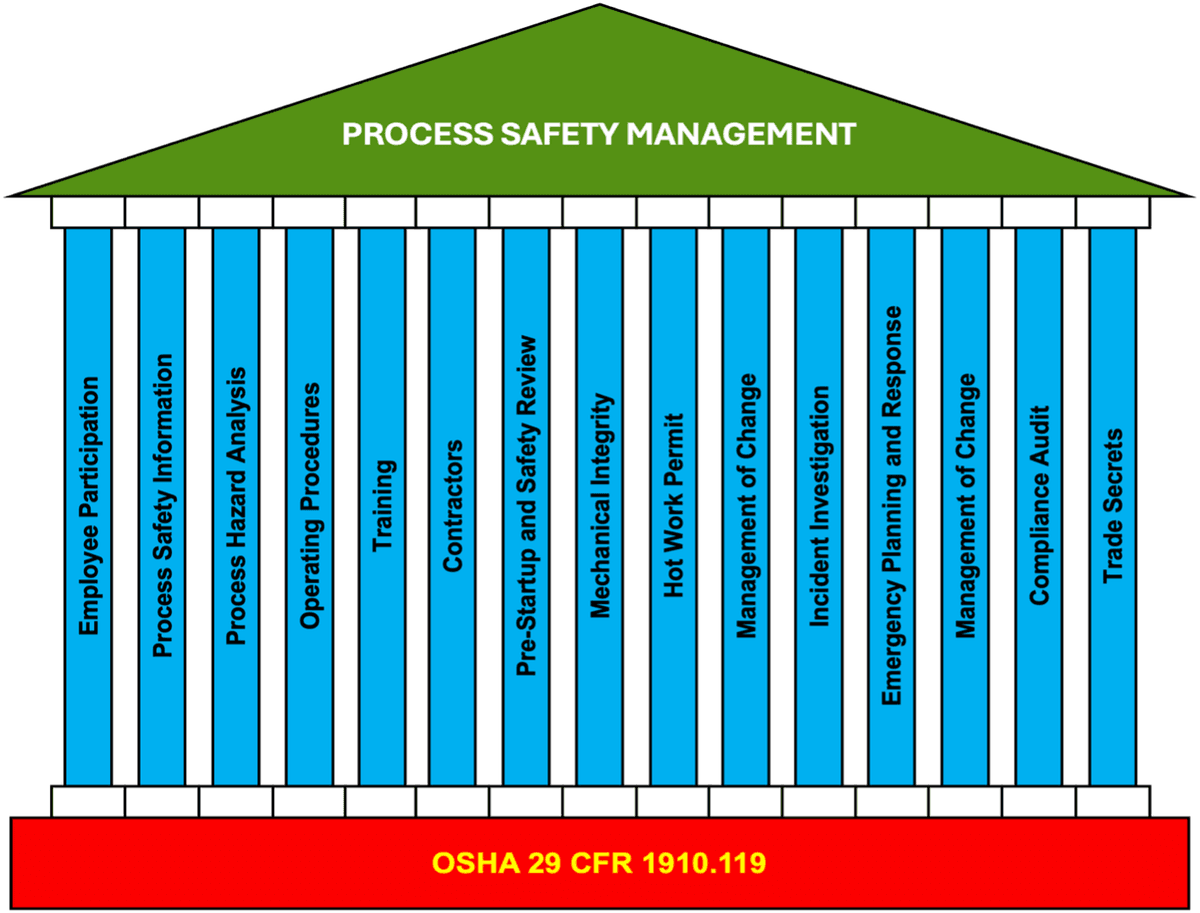
OSHA Process Safety Management (29 CFR 1910.119) element by element
Each element below has its own dedicated implementation page with focused methodology, flow chart, and individual significance for organisations. Click any element to explore.
A written plan that gives employees access to process safety information and a real voice in how the PSM programme is developed
The chemistry, technology, and equipment information for your process kept current and accessible to the people who need it
The initial process hazard analysis and the five year revalidation, run with HAZOP, What If, Checklist, or whatever method fits the process
Written procedures covering normal, startup, shutdown, and emergency operations, certified accurate every year
Initial training before assignment and refresher training at intervals of no more than three years
Selection based on safety performance, pre job orientation, injury tracking, and periodic evaluation of contractors
The verification before highly hazardous chemicals are introduced that confirms design, construction, and PSM readiness
Written procedures, training, inspection and testing, and correction of deficiencies for safety critical equipment
The permit that controls fire prevention requirements during hot work on or near covered processes
Written procedures that control changes to process chemicals, technology, equipment, and procedures
Investigation of any incident with catastrophic release potential, begun within forty eight hours
An emergency action plan under 1910.38 and a HAZWOPER response plan under 1910.120(q) for releases of highly hazardous chemicals
The certification at least every three years that procedures and practices comply with the PSM standard
A trade secret claim does not relieve the disclosure obligations that run through PSM paragraphs (a) to (o)
How the system is implemented
We open at appendix a applicability & covered process boundary and close at compliance audit protocol & corrective action register, and each stage hands the next one a record rather than a summary of it.
Determine Appendix A threshold quantity applicability per regulated HHC list, map covered process boundaries including all interconnected equipment, pressure relief routing, and shared utilities, identify co located processes and exclusions (retail, atmospheric storage), document Threshold Quantity inventory register.
Conduct element by element PSM compliance audit against the OSHA NEP inspection checklist (CPL 03 00 021 / 03 to 00 to 014), score each element for documentary evidence, programme execution quality, and finding traceability, identify Willful, Serious, and OTI class citation exposures.
Audit P&ID as built accuracy, MOC backlog register, and PSI document control history, implement accelerated MOC backlog review with risk ranking, re issue affected P&IDs, equipment datasheets, and MAWP records, establish PSI change management procedure preventing future backlog accumulation.
Establish 5 year PHA revalidation and interim trigger programme, issue action register with risk rank gating, ownership, and completion date, build CSB recommendation aligned close out tracker, integrate HAZOP findings into MI, MOC, and PSSR workflows with evidence based close out status.
Implement MI programme per API RP 580 RBI with damage mechanism register, inspection frequency risk ranking, and NDE specification, deploy PSSR line item discipline covering mechanical, ESD, SIS, and ATEX pre start items, build contractor pre qualification, training, audit, and performance review programme per OSHA Appendix C.
Design 3 year compliance audit per OSHA (o) using structured interview guides, document review matrices, and field observation protocols, build corrective action register with risk rank gating and management of record sign off, produce re defensibility pack including evidence library and interview preparation guide.

What the system covers in full
Outcomes of OSHA Process Safety Management (29 CFR 1910.119)
- We disrupt the precursor chain that leads to catastrophic highly hazardous chemical releases
- We embed the lessons of Bhopal and Piper Alpha into element level discipline
- We close the systemic gaps that CSB has repeatedly cited in refinery and chemical events
- We build defence in depth that aligns with CCPS Vision 20/20 outcomes
- We make your programme defensible across all 14 elements during an OSHA NEP inspection
- We document programme execution to the standard an inspector examines for willful and repeat findings
- We align your EPA RMP Subpart C and D obligations with PSM evidence so you cover both at once
- We make sure you withstand CSB and state PSM overlay scrutiny under CalARP, NJ TCPA and Contra Costa ISO
- We reduce the operator error contribution to Tier 1 events through procedural consistency
- We use MOC rigour to stop creeping change from introducing unanalysed hazards
- We use PSSR discipline to prevent startup of misconfigured or partially commissioned units
- We cut the third party share of your incident exposure through stronger contractor management
- We close the documentation gaps an OSHA inspection is most likely to open
- We build the programme record that a post incident review examines
- We give your underwriters demonstrable PSM maturity to assess
- We protect your production guarantees and the continuous operation commitments you have made to customers
Codes & standards we work to
Triggers that signal the need
Where OSHA Process Safety Management (29 CFR 1910.119) applies
Tangible deliverables
- PSM 14 element gap assessment aligned to the OSHA inspection checklist
- Appendix A threshold quantity inventory and covered process boundary register
- PSI re accuracy and document control programme
- PHA and HAZOP revalidation schedule with an action close out tracker
- Hierarchical operating procedure suite covering normal, startup, shutdown and emergency
- MOC procedure and electronic workflow specification
- Mechanical integrity programme integrated with API RP 580 RBI
- PSSR checklist library with a sign off matrix
- Contractor pre qualification and audit programme
- Compliance audit protocol per OSHA paragraph o with a corrective action register
Send us the scope
We will scope OSHA Process Safety Management (29 CFR 1910.119) against your site and come back with what it would take. Send us the unit, the P&ID revision it sits at and the inventory it holds.