Risk Based Process Safety (RBPS)
We deploy CCPS RBPS so that your safety effort is calibrated to real risk rather than spent on box ticking
Risk Based Process
Safety (RBPS)
Risk Based Process Safety was codified by the CCPS in 2007 and has been refined through more than a decade of major accident learning that revisited Texas City, Buncefield, Jaipur and Bhopal. It is now the prevailing global PSM architecture. The framework restructures the 14 OSHA elements into 20 RBPS elements organised under four pillars that ask your organisation to commit to process safety, understand hazards and risk, manage risk and learn from experience, and it deliberately scales effort against process safety risk. When our team deploys a mature RBPS programme we shift your resourcing toward the high consequence end of the inventory, break the compliance plateau that traps PSM 1.0 organisations and give your board and regulator a defensible API RP 754 Tier 1 to 4 metric set.
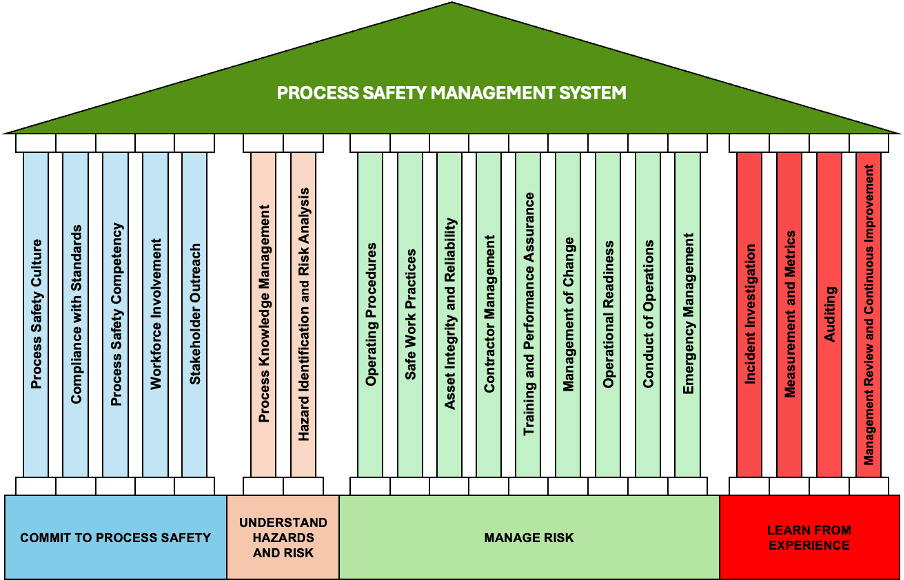
Risk Based Process Safety (RBPS) element by element
Each element below has its own dedicated implementation page with focused methodology, flow chart, and individual significance for organisations. Click any element to explore.
The leadership and behaviour foundation that sits beneath every other RBPS element
A live register of regulatory, industry, and corporate standards with full traceability
A role mapped competency framework with CPD, certification, and assurance
Operator and contractor participation in PHA, MOC, near miss reporting, and behaviour based safety
Community, regulator, and value chain communication about hazards and response
Validated normal, abnormal, and emergency procedures kept current right at the workstation
Permit to work, lockout tagout, hot work, confined space, and line breaking as daily operational controls
Risk based inspection, reliability centred maintenance, fitness for service, and integrity operating windows that keep ageing assets fit for service
Pre qualification, induction, supervision, and performance through OSHA PSM (h) and OISD 149
Role based training delivery with competency assessment and retraining triggers
Governance of engineering, organisational, and procedural change with PHA, SIL, and FERA triggers
A pre startup safety review that closes the gap between construction completion and live operation
Day to day operating discipline across shift handover, alarm response, and abnormal situation management
Emergency response, business continuity, incident command, command centre, drills, and mutual aid tested against credible worst case scenarios
Multi method root cause analysis with corrective action close out and recurrence prevention
API RP 754 Tier 1 to 4 process safety event indicators, both lagging and leading, made visible to leadership
An internal annual, corporate triennial, statutory, and insurer audit programme with finding closure governance
The annual leadership review of programme effectiveness where targets are set and the improvement roadmap is built
How the system is implemented
We open at rbps maturity diagnostic & risk effort baseline and close at governance roadmap, audit cycle & vision 20/20, and each stage hands the next one a record rather than a summary of it.
Conduct 20 element maturity diagnostic calibrated on the CCPS 1, 5 scale with cross functional site team, map current state by pillar (Commit / Understand / Manage / Learn), establish risk effort calibration comparing current PSM resource allocation against the facility's credible MAH inventory.
Audit Process Safety Information for accuracy and completeness across P&IDs, as built documentation, equipment datasheets, MAWP, and chemical data, design the PSI single source of truth architecture, document control, GIS, CMMS, and engineering data, and clear the MOC backlog.
Establish the 5 year statutory PHA/HAZOP revalidation cycle with event driven and MOC triggered supplementary reviews, define study scope, node prioritisation, and action close out tracking against OSHA 1910.119(e) and CCPS guidelines, integrate HAZOP findings into LOPA and Bow Tie workflows.
Implement Management of Change procedure with temporary, permanent, and organisational change classifications, deploy PSSR checklist library covering mechanical, instrumentation, ATEX, and process pre requisites, build operating procedure architecture (normal / startup / shutdown / emergency / abnormal) per OSHA (f).
Specify Tier 1, 4 PSE leading and lagging indicators including demand rate, near miss frequency, safeguard impairment, and audit findings, design board grade dashboard, administer CCPS culture survey or Hudson process safety culture ladder assessment to baseline leadership and workforce safety culture.
Assign element level accountable executives with RACI, build quarterly assurance cycle and annual self audit programme, issue 3 year RBPS roadmap with element milestones, capex envelope, and Vision 20/20 alignment committed culture, vibrant management systems, disciplined adherence, and intentional competency.

What the system covers in full
Outcomes of Risk Based Process Safety (RBPS)
- We help you reduce Tier 1 process safety event frequency demonstrably across multi year baselines
- We concentrate safeguards and verification on the dominant major accident hazard contributors
- We disrupt the incident precursor chains that your Tier 3 and Tier 4 leading indicators reveal
- We close the systemic gaps that the Bhopal era and Texas City era taught the industry
- We align your OSHA PSM, EPA RMP and Seveso III obligations under one operating model
- We give you API RP 754 aligned evidence that satisfies regulators, insurers and lenders
- We make sure your programme withstands HSE, OSHA NEP and pollution control board inspection without a rebuild
- We anchor the second party assurance your joint venture and tolling partners ask for
- We cut your MOC throughput time without reducing rigour
- We eliminate duplicate PSI repositories and give you one engineering source of truth
- We drive operator competency to demonstrable role based standards
- We accelerate your incident learning loop from event to action close out
- We defer reactive PSM spend so that funding flows to the credible major accident hazard set
- We give your underwriters a documented RBPS maturity progression to price against
- We evidence your OSHA, RMP and Seveso obligations element by element
- We protect your production guarantees, debt covenants and licence to operate
Codes & standards we work to
Triggers that signal the need
Where Risk Based Process Safety (RBPS) applies
Tangible deliverables
- RBPS 20 element maturity diagnostic with site calibrated 1 to 5 scores
- Three year RBPS roadmap with element level milestones and a capex envelope
- PSI architecture blueprint that ties out document, GIS, CMMS and engineering data
- API RP 754 Tier 1 to 4 KPI specification and board grade dashboard
- MOC and PSSR procedure suite with electronic workflow specification
- PHA and HAZOP revalidation schedule and trigger matrix
- Competency model with role based assessment and refresher cycle
- Annual self audit protocol with a management review pack
Send us the scope
We will scope Risk Based Process Safety (RBPS) against your site and come back with what it would take. Send us the unit, the P&ID revision it sits at and the inventory it holds.